
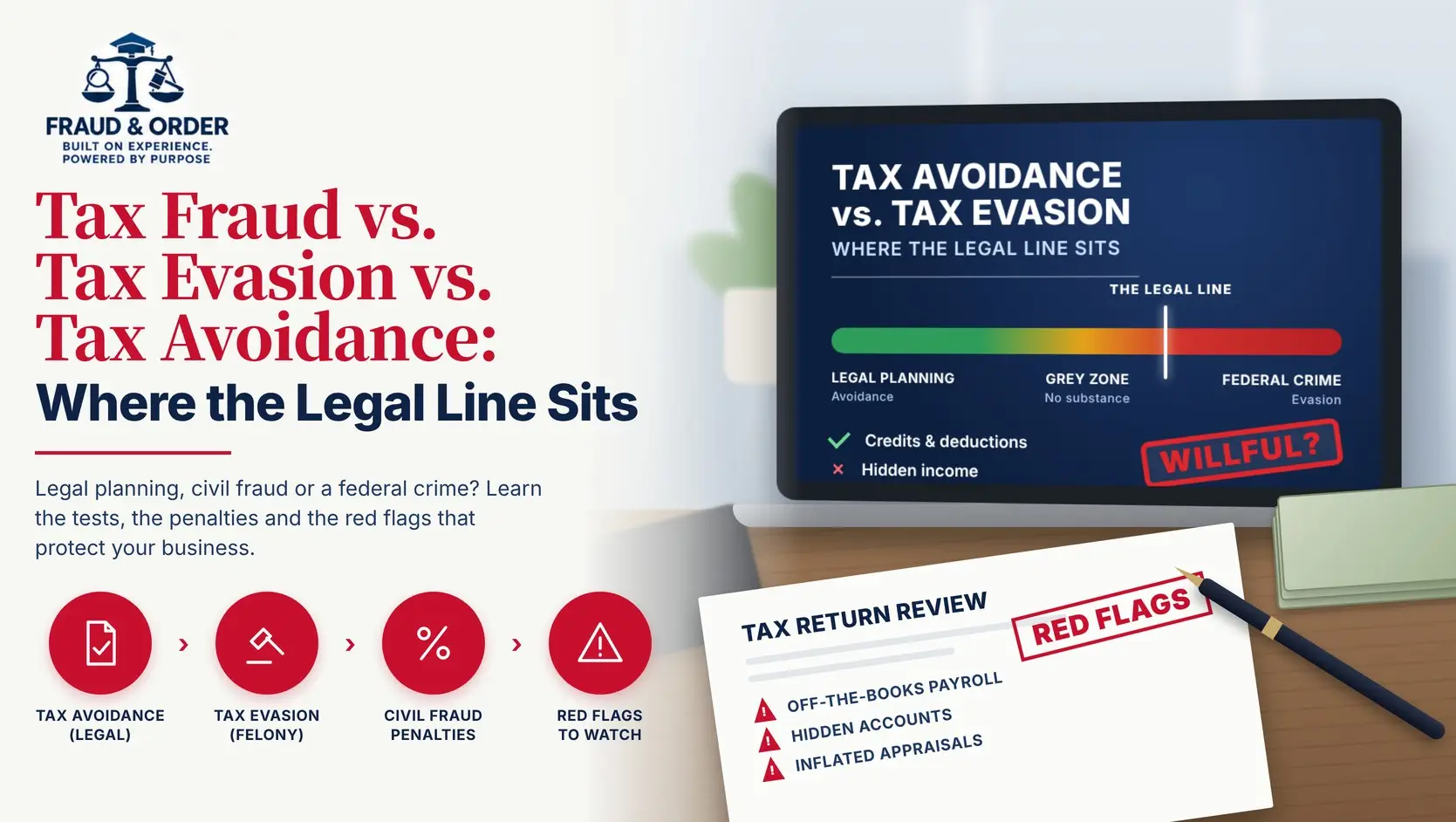
A manufacturer moves a profitable product line into a subsidiary to capture a state tax credit. A restaurant owner pays half the kitchen staff in cash and leaves those wages off the books. A consultant books a family beach trip as a “client retreat.” All three cut their tax bills, but only one is clearly legal. The difference is intent, disclosure, and substance.
Enforcement data shows why this distinction matters now. In fiscal year 2025, IRS Criminal Investigation (IRS-CI) identified $10.59 billion in financial crimes, and $4.5 billion of that was tax fraud, a 111.8% jump over the prior year. Nearly 64% of its investigative time went to tax crimes, often using data analytics to surface payroll schemes. The IRS also projected a $696 billion gross tax gap for tax year 2022, its most recent published estimate.
For executives and auditors, understanding tax evasion vs. tax avoidance is a core risk skill, not a technicality. Here is where the line sits.
Tax Evasion vs. Tax Avoidance: The Short Answer
Tax avoidance is using the tax code as written to lower what you owe. It is legal. Tax evasion is willfully hiding income or misrepresenting facts to escape tax that is legally due. It is a federal felony. Tax fraud is the broader umbrella for intentional deception on tax matters, and it can be pursued civilly, criminally, or both.
| Factor | Tax Avoidance | Tax Evasion | Tax Fraud (civil) |
|---|---|---|---|
| Legal status | Legal | Felony (26 U.S.C. § 7201) | Civil penalty (IRC § 6663) |
| Key test | Real economic substance | Willfulness plus an affirmative act | Fraudulent intent, clear and convincing proof |
| Typical example | Retirement plan contributions, credits, entity choice | Off-the-books payroll, hidden accounts | Fabricated deductions on a filed return |
| Main exposure | Possible 20% to 40% penalty if aggressive | Up to 5 years in prison | 75% of the fraudulent underpayment |
The tax evasion vs. tax avoidance question almost always comes down to one word: willfulness.
Tax Avoidance: Legal Until It Lacks Substance
In the Gregory litigation of the 1930s, Judge Learned Hand wrote that no one owes a duty to choose the most heavily taxed path. Yet the Supreme Court still disallowed that taxpayer’s reorganization because it had no real business purpose. That case is still the starting point for any tax evasion vs. tax avoidance analysis.
That idea now lives in the Internal Revenue Code. Under Section 7701(o), a transaction must meaningfully change your economic position and serve a substantial non-tax purpose. If it fails, a strict liability penalty of 20% applies, rising to 40% for undisclosed transactions, with no reasonable cause defense.
This grey zone is where many organizations get hurt. The IRS’s 2026 Dirty Dozen list flags noncash charitable schemes built on inflated appraisals, including syndicated conservation easements and art. They are sold as avoidance; the IRS treats them as abuse.
Tax Evasion: Where Willfulness Turns Planning Into a Crime
Under 26 U.S.C. § 7201, prosecutors must prove three things: a tax deficiency, willful intent, and an affirmative act of evasion. Concealment, not mere nonpayment, is what makes it a crime.
The statute sets prison terms of up to five years and fines of up to $100,000 for individuals or $500,000 for corporations. The Justice Department notes that general federal sentencing law can raise the individual fine ceiling to at least $250,000.
Real-world example: The Justice Department’s Tax Division announced a guilty plea from a Staten Island upholstery company owner who paid about $2.6 million in off-the-books cash wages between 2015 and 2021. He withheld nothing, hid the cash payroll from his own return preparer, and caused a tax loss of $486,753. Hiding facts from your accountant is a classic sign of willfulness.
Tax Fraud: Civil Exposure Without a Prosecution
The IRS can impose a civil fraud penalty equal to 75% of the underpayment attributable to fraud. The agency must prove fraud by clear and convincing evidence, but once it proves fraud on any portion, the entire underpayment is treated as fraudulent unless the taxpayer proves otherwise. Fraudulent returns also have no statute of limitations, so old years stay open indefinitely.
Filing a return you know is materially false can also be charged under 26 U.S.C. § 7206(1), a felony with up to three years in prison.
Red Flags Investigators Look For
In practice, the tax evasion vs. tax avoidance line shows up in records. Whether reviewing a vendor, an acquisition target, or your own books, watch for:
- Two sets of records or cash sales that never reach the general ledger
- Payroll withholdings collected but not remitted to the IRS
- Personal expenses booked as business costs, especially travel, vehicles, and family payroll
- Appraisals that look engineered to support a deduction
- Information withheld from the tax preparer or auditors
- Funds routed through layered entities or accounts with no operating purpose
These patterns often surface through data analytics in fraud detection. Shell-company flows call for the tracing methods in Money Laundering 101, and file metadata often exposes backdated records, as shown in Following the Digital Trail.
How to Stay on the Right Side of the Line
Clarity on tax evasion vs. tax avoidance only helps if it shapes daily controls. Start here:
- Document the business purpose before the deal closes. Record the non-tax reason for any restructuring or major deduction at the time, not after an audit notice.
- Disclose aggressive positions. Disclosure can cut the economic substance penalty from 40% to 20% and undermines any claim of concealment.
- Separate payroll duties. The person who calculates withholdings should not be the only one confirming deposits. Reconcile payroll tax deposits monthly.
- Vet promoters. If a “strategy” appears on the IRS Dirty Dozen list or promises savings far larger than the money at risk, get an independent opinion.
- Give employees a safe reporting channel. Staff often spot schemes first. See building a whistleblower hotline that employees actually use.
- Preserve records. Destroying files creates new liability, and deleted data is often recoverable.
- Bring in counsel first when you suspect a problem. Forensic accountants engaged through counsel can help protect privilege.
Conclusion: Intent Draws the Line
The gap between tax evasion vs. tax avoidance is not measured in dollars saved. It is measured by honesty, disclosure, and genuine business substance. With IRS-CI more than doubling identified tax fraud in a single year, organizations cannot treat tax evasion vs. tax avoidance as a grey area.
Explore real investigations in our Case Files, or contact Fraud & Order to discuss a concern. If you are a victim or whistleblower, the Fraud & Order Foundation can help.
Frequently Asked Questions
What is the main difference in tax evasion vs. tax avoidance?
In the tax evasion vs. tax avoidance comparison, avoidance uses legal provisions such as deductions, credits, and retirement plans to reduce tax. Tax evasion involves willfully concealing income or falsifying information to escape tax that is owed. The deciding factor is intent combined with an act of deception.
Is tax fraud the same as tax evasion?
Not exactly. Tax fraud is a broad term for intentional deception on tax matters, and the IRS can address it with a 75% civil penalty without any criminal charge. Tax evasion is a specific felony under 26 U.S.C. § 7201 that requires proof of willfulness and an affirmative act.
Can aggressive tax planning become illegal?
Yes. A transaction that follows the letter of the law but has no real economic substance or business purpose can be disallowed under Section 7701(o). Penalties reach 40% if the transaction was not disclosed, and deliberate concealment can push the matter into evasion.
Is an honest mistake on a tax return considered tax evasion?
Generally no. Evasion requires willfulness, meaning a deliberate violation of a known legal duty. Honest errors usually lead to corrections, interest, and possibly civil accuracy penalties rather than criminal charges.
Can a company be prosecuted for tax evasion?
Yes. Section 7201 applies to corporations, with fines of up to $500,000 under the statute. Individual officers who direct or approve the scheme can also face personal charges.
What should a business do if it suspects internal tax fraud?
Preserve records immediately, limit discussion to a need-to-know group, and contact experienced legal counsel before taking further action. Counsel can then coordinate a forensic review in a way that helps protect privilege and evidence.
References
- Internal Revenue Service. (2025). IRS-CI issues fiscal year 2025 annual report showcasing banner investigative results. https://www.irs.gov/node/153186
- Internal Revenue Service Criminal Investigation. (2025). Annual Report 2025 (Publication 3583). https://www.irs.gov/pub/irs-pdf/p3583.pdf
- Internal Revenue Service. (2026). Dirty Dozen tax scams for 2026: IRS reminds taxpayers to watch out for dangerous threats. https://www.irs.gov/newsroom/dirty-dozen-tax-scams-for-2026-irs-reminds-taxpayers-to-watch-out-for-dangerous-threats
- U.S. Department of Justice, Tax Division. (2024). Criminal Tax Manual, Chapter 8: Attempt to Evade or Defeat Tax. https://www.justice.gov/tax/media/1351781/dl
- U.S. Department of Justice, Office of Public Affairs. (2024). New York man pleads guilty to employment tax violation. https://www.justice.gov/opa/pr/new-york-man-pleads-guilty-employment-tax-violation
- U.S. Government Publishing Office. (2023). 26 U.S.C. Chapter 75, Subchapter A: Crimes. https://www.govinfo.gov/content/pkg/USCODE-2023-title26/html/USCODE-2023-title26-subtitleF-chap75-subchapA.htm
- Tax Policy Center. (2025). Delayed IRS tax gap estimates could obscure policy and staffing impacts. https://taxpolicycenter.org/taxvox/delayed-irs-tax-gap-estimates-could-obscure-policy-and-staffing-impacts
- Crowe LLP. (n.d.). Codified economic substance: 5 things to know. https://www.crowe.com/insights/tax-news-highlights/codified-economic-substance-5-things-to-know
- Association of Certified Fraud Examiners. (2026). Occupational Fraud 2026: A Report to the Nations. https://www.acfe.com/report-to-the-nations
- AICPA & CIMA. (2024). Statements on Standards for Tax Services (SSTS). https://www.aicpa-cima.com/resources/toolkit/statements-on-standards-for-tax-services
Disclaimer
This article is for general informational purposes only and does not constitute legal, tax, financial, or other professional advice. Reading it does not create an attorney-client or other professional relationship with Fraud & Order. Consult qualified professionals about your specific situation. For questions about FraudOrder services, visit https://fraudorder.co/
- .