
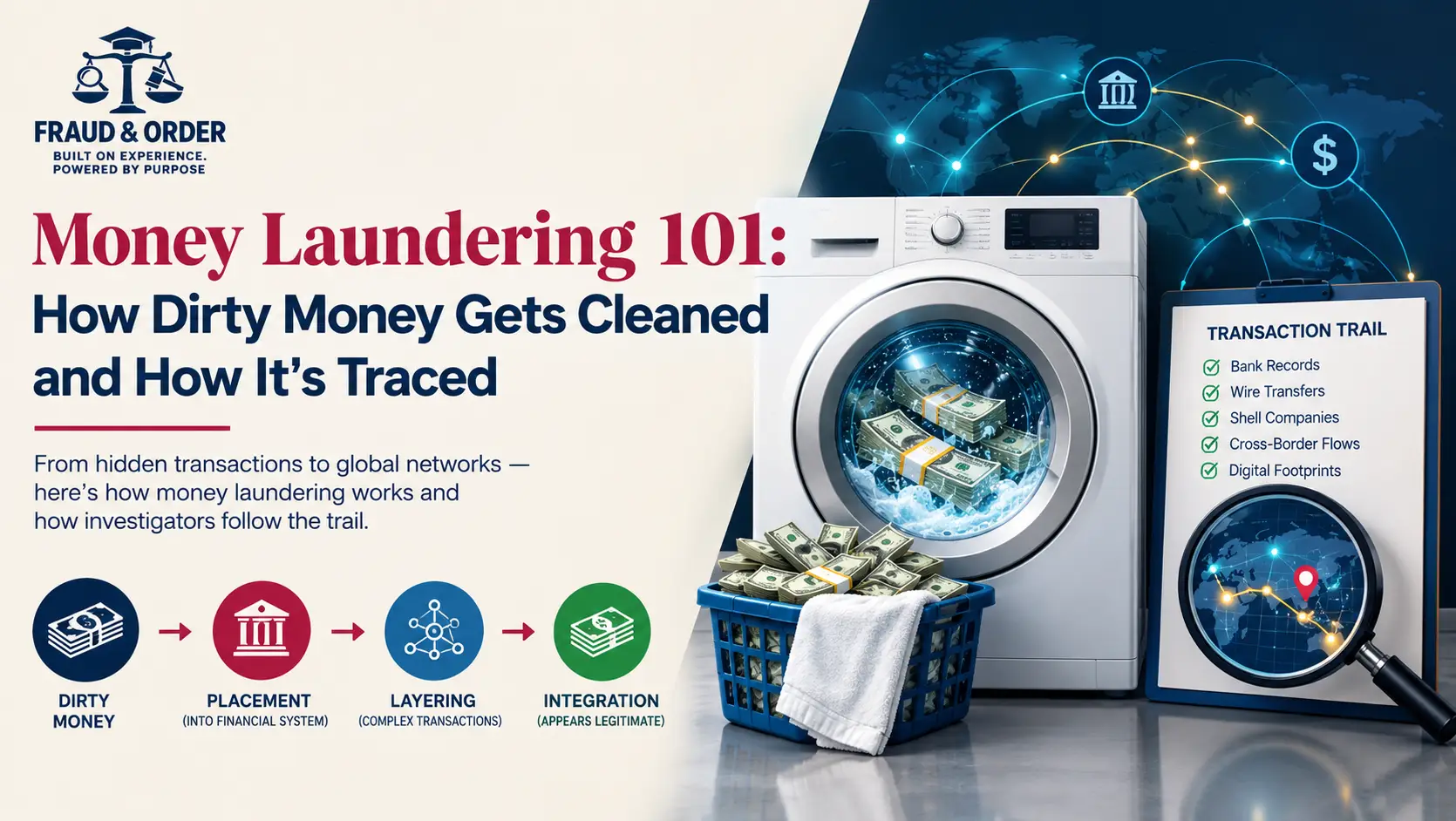
Every fraud ends with the same question: where did the money go? The United Nations estimates that 2% to 5% of global GDP, roughly $800 billion to $2 trillion a year, is laundered. U.S. financial institutions filed 4.7 million suspicious activity reports with FinCEN in fiscal 2024. Chainalysis reports that illicit on-chain laundering grew from about $10 billion in 2020 to more than $82 billion in 2025. Treasury’s 2026 risk assessment names fraud among the leading threats.
If you lead a business, a compliance function, or an audit team, understanding how money laundering works is now a core risk skill. This guide explains how criminals clean funds, how investigators trace them, and what your organization can do this quarter.
How Money Laundering Works: The Three Stages
Regulators describe three stages. They overlap in real cases, but the model shows your team where to look.
- Placement: Illicit proceeds first enter the financial system, often through deposits, cash-heavy businesses, prepaid products, or accounts held in another person’s name.
- Layering: Funds move through multiple accounts, entities, jurisdictions, or asset types to break the paper trail.
- Integration: The money returns looking legitimate, as business revenue, loan repayments, real estate, or investments.
Picture an employee who diverts $400,000 through a fake vendor, then routes it through a relative’s company into a property purchase. The diversion is fraud. Everything after it is laundering, and each step leaves records.
Where Organizations Get Exposed
Criminals adapt how money laundering works to whichever channel is weakest:
- Cash-intensive operations, where deposits are hard to compare against real sales.
- Third-party and shell entities, which Treasury links to complicit intermediaries and regulatory gaps.
- Trade and invoice activity, where pricing or quantity does not match the goods (the FATF publishes risk indicators).
- Digital assets and mule networks. Chainalysis found that Chinese-language laundering networks processed about $16.1 billion in 2025, roughly 20% of attributed illicit laundering.
- Proceeds of internal fraud, moving through payables or payroll.
Red Flags Your Team Can Spot Early
Understanding how money laundering works means recognizing patterns that do not fit a business purpose:
- Payments from or to parties with no clear connection to the contract
- Rapid movement of funds in and out with little business activity
- Activity that appears designed to stay under reporting thresholds
- Counterparties who resist explaining ownership or source of funds
- Vendors with no verifiable footprint, or unusually close personal ties to staff
Cash payments over $10,000 trigger Form 8300 for most businesses, and FinCEN received 470,400 of them in fiscal 2024. Behavioral signals matter too. ACFE’s 2026 report associates an unusually close vendor relationship with a $300,000 median loss, and heavy internal pressure with $532,000. These are red flags for review, not proof of wrongdoing.
How Dirty Money Is Traced
Investigators reverse how money laundering works: they follow the money backward instead of starting with a suspect.
- Bank and BSA records. In fiscal 2024, 432 federal, state, and local agencies ran more than 2.3 million searches of FinCEN’s database.
- Forensic accounting. Analysts rebuild flows, reconcile deposits to documented income, and compare lifestyle to known earnings.
- Entity and ownership mapping. Corporate filings, addresses, signatories, and counterparties reveal who really sits behind a payment.
- Blockchain analytics. Public ledgers make crypto movements visible, as covered in our guide on how investigators trace money on the blockchain.
- Digital forensics. Logs, metadata, and recovered files tie transactions to people. See how investigators use metadata, logs, and devices and how deleted evidence is recovered.
Traces get harder when funds cross borders or pass through privacy tools, so speed matters. Payment fraud moves fast, as our guide to wire fraud and business email compromise explains.
What Changed in 2026 for Compliance Teams
Rules shape how money laundering works in practice, and they moved this year:
- In March, FinCEN assessed an $80 million penalty against Canaccord Genuity, its largest BSA penalty against a broker-dealer.
- In April, FinCEN proposed modernizing AML program requirements and separately proposed a whistleblower rule with awards of up to 30% of sanctions over $1 million. Both remain proposals.
- In June, FinCEN guidance clarified that 314(b) information sharing covers fraud-related activity.
Your Action Plan for Spotting How Money Laundering Works Inside Your Organization
- Run a risk assessment covering customers, vendors, products, geographies, and payment channels.
- Verify who you deal with. Collect ownership information and screen counterparties before onboarding.
- Monitor transactions for the red flags above, using data analytics, not only manual review.
- Open a confidential reporting channel. ACFE links proactive monitoring and surprise audits to lower losses.
- Escalate with counsel and preserve evidence. Do not alert the subject or alter records.
- Train staff and update controls, starting with the internal controls that actually stop theft.
Move Before the Money Does
Knowing how money laundering works lets you spot trouble while funds are still reachable. If you suspect laundering, embezzlement, or concealed assets, FraudOrder supports corporate crime and embezzlement investigations. Contact us for a confidential talk.
Frequently Asked Questions
What is money laundering in simple terms?
Here is how money laundering works in one line: criminals disguise the illegal origin of money so it looks legitimate.
Does my business need an AML program?
Banks, broker-dealers, money services businesses, and other covered institutions have formal AML obligations. Most other businesses must still report cash payments over $10,000 on Form 8300. Consult counsel about your specific duties.
What is the difference between fraud and money laundering?
Fraud generates illicit funds. Laundering hides and reuses them, and it can be charged separately.
Can cryptocurrency laundering be traced?
Often, yes, because public blockchains record transactions. Tracing gets harder when funds move through privacy tools or services that cooperate poorly with investigators.
What should I do if I suspect money laundering?
Preserve records, limit who knows, and involve legal counsel and a qualified fraud examiner. Regulated entities may have suspicious activity reporting duties.
How does understanding how money laundering works help my company?
It helps you build controls that catch warning signs earlier, reduce regulatory exposure, and recover assets faster.
References
- United Nations Office on Drugs and Crime. (2026). Money laundering overview. https://www.unodc.org/unodc/en/money-laundering/overview.html
- Financial Crimes Enforcement Network. (2025). FinCEN year in review for FY 2024. https://www.fincen.gov/system/files/2025-08/FinCEN-Infographic-Public-2025-508.pdf
- Gibson Dunn. (2026). Mid-year developments in anti-money laundering in 2026. https://www.gibsondunn.com/mid-year-developments-in-anti-money-laundering-in-2026/
- Orrick. (2026). Treasury releases 2026 national risk assessments. https://infobytes.orrick.com/2026-03-13/treasury-releases-2026-national-risk-assessments/
- United Against Bad Banking Online (UAB). (2026). Chinese-language money laundering networks processed $16.1B in illicit crypto: Chainalysis. https://uabonline.org/english-news/chinese-language-money-laundering-networks-processed-16-1b-in-illicit-crypto-chainalysis/
- Association of Certified Fraud Examiners. (2026). Occupational fraud 2026: A report to the nations. https://www.acfe.com/rttn
- Financial Action Task Force. (2021). Trade-based money laundering risk indicators. https://www.fatf-gafi.org/content/dam/fatf-gafi/reports/Trade-Based-Money-Laundering-Risk-Indicators.pdf
Disclaimer
This article is for informational purposes only and is not legal, financial, or professional advice. Reading it does not create a client relationship with FraudOrder. Laws and regulatory proposals change, so consult qualified legal, compliance, or forensic professionals for your specific situation.
For questions about FraudOrder services, visit https://fraudorder.co/