
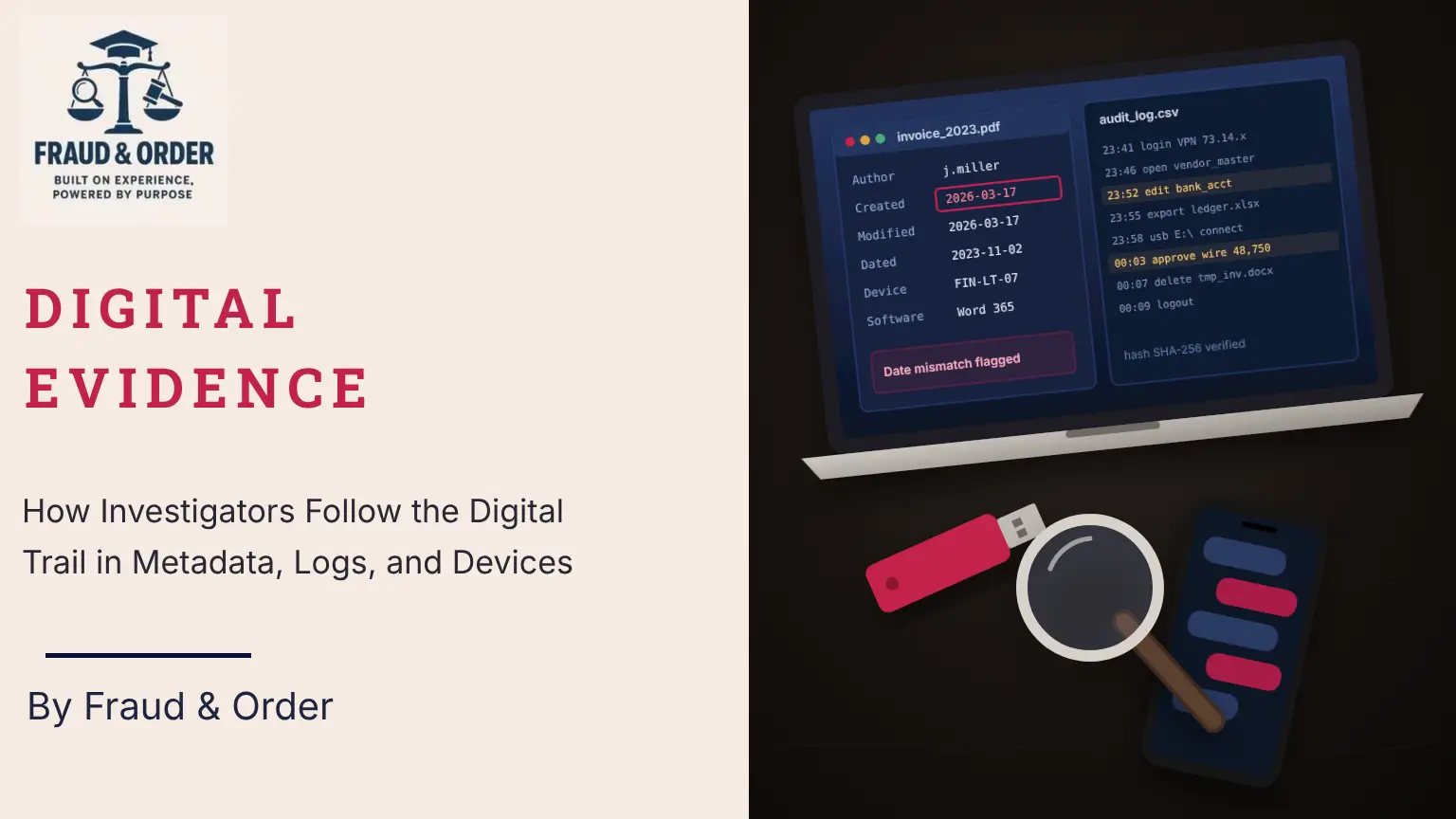
An invoice looks perfect. The amounts match the purchase order, the vendor is approved, and the signature is right where it should be. Then an investigator opens the file properties and sees something odd: the “2023” invoice was created last Tuesday, on the laptop of the employee who approved it.
That is the power of digital evidence. People can edit a document, but it is far harder to edit the invisible record of who touched it, when, and from where.
The stakes are high. According to the ACFE’s Occupational Fraud 2026: A Report to the Nations, which analyzed 2,402 cases across 143 countries, organizations lose an estimated 5% of revenue to fraud each year, with a median loss of $104,000 per case and schemes typically running about 12 months before discovery. Concealment is often digital: in the ACFE’s 2024 report, 31% of fraudsters created fake electronic documents and 28% altered real ones. Every one of those actions leaves digital evidence behind.
What Counts as Digital Evidence?
Digital evidence is any information stored or transmitted electronically that can help prove or disprove what happened. In fraud cases, it usually falls into three groups:
- Metadata: data about data, such as when a file was created, who last saved it, and what software produced it
- Logs: system records of activity, such as logins, file access, email sends, and payment approvals
- Devices: laptops, phones, USB drives, and servers that store files, messages, and usage history
Alone, each piece may mean little. Together, they let investigators rebuild a timeline that is very hard to argue with. For the bigger picture, see the role of digital forensics in modern fraud investigations.
Metadata: The Story Behind the File
Every document carries details most users never see. Investigators routinely examine:
- Creation and modification dates that may contradict the date typed on the document
- Author and “last saved by” fields that show which account or computer produced a file
- Software and template information that reveals how a record was really made
- Email headers showing the true sending server, routing path, and time zone
- Photo data (EXIF) such as the device used and, sometimes, location
Metadata catches backdating and fabrication. In one case we covered, a $40 million fraud exposed by a wrong date on an invoice, a service period that came before the contract was signed opened the door to a much larger scheme.
Even outside fraud, metadata has cracked famous cases. In 2005, Wichita police traced a floppy disk mailed by the BTK killer to a computer at his church, a key step in identifying Dennis Rader, who later pleaded guilty.
A word of caution: metadata can be changed, and copying files carelessly can overwrite it. That is why this kind of digital evidence must be collected with forensic tools, not by forwarding files around the office.
Logs: The Record of Who Did What, and When
If metadata tells the story of a file, logs tell the story of a person’s actions. Valuable sources of digital evidence include:
- Accounting and ERP audit trails showing who created a vendor, changed bank details, or approved a payment
- Email and cloud logs from platforms like Microsoft 365 or Google Workspace, showing logins, downloads, forwarding rules, and deletions
- Access logs from badge systems, VPNs, and remote desktop tools
- Banking portal logs showing which user initiated or released a wire
Logs are especially powerful for “it wasn’t me” defenses. If a vendor’s bank details changed at 11:52 p.m. from a home IP address using one employee’s credentials, that is hard to explain away. Tying those records to the money is where documentation matters, as we explain in how to document financial fraud so it holds up in court.
But logs do not last forever. In Microsoft Purview Audit (Standard), for example, records are kept for 180 days by default. Organizations that never check retention settings often discover, too late, that the most important months are already gone.
Devices: Where the Evidence Lives
Company laptops, phones, and storage devices often hold the clearest digital evidence of intent. Forensic examiners look for:
- Files, drafts, and spreadsheets saved locally or on USB drives
- Browser history, including visits to personal banking or crypto sites
- Text and chat messages, which often reveal coordination or motive
- USB connection records showing when data was copied off
- Cloud sync folders that keep copies the user forgot about
Messages are frequently the turning point. Our breakdown of a CFO fraud exposed by a single text message shows how one conversation can unravel years of concealment.
Device collection also raises legal questions. Company-owned devices with clear acceptable-use policies are far easier to examine than personal phones, and privacy and consent laws vary by state.
Making Digital Evidence Hold Up in Court
Finding digital evidence is only half the job. It must also be admissible. Strong investigations follow a disciplined process:
- Preserve first. Create a verified forensic copy before anyone opens the files.
- Verify with hash values. A hash is a digital fingerprint that proves a copy matches the original. Federal Rule of Evidence 902(14), in effect since 2017, allows data copied from a device to be self-authenticated through a qualified person’s certification of that kind of match.
- Maintain chain of custody. Document every person who handled the evidence and when.
- Correlate sources. Match metadata and logs to bank records and ledgers so the digital trail connects to the money.
- Report clearly. Findings must be explainable to judges, juries, and insurers.
Shortcuts here can sink a strong case. Learn more in our guide to admissible evidence in court vs. thrown out.
What Your Organization Should Do Now
You can protect future digital evidence today, before anything goes wrong:
- Check log retention in your email, cloud, ERP, and banking platforms, and extend it where possible.
- Turn on audit trails in your accounting system, and restrict who can disable them.
- Use company-owned devices for finance roles, backed by a written acceptable-use policy.
- Create a litigation hold process so auto-deletion stops the moment fraud is suspected.
- Train IT not to investigate alone. Well-meaning checks can overwrite metadata and logs.
When fraud is suspected, the first hours matter most. Our checklist for the first 48 hours after discovering fraud walks through exactly what to secure.
Conclusion: The Trail Is There If You Protect It
Fraudsters focus on what people can see: the numbers, the signatures, the paperwork. Digital evidence lives in what they forget: file properties, system logs, and the devices in their hands. Followed carefully, that trail can show not just what happened, but who did it and when.
The difference between a strong case and a lost one often comes down to preservation and method. FraudOrder’s forensic accountants and investigators collect and analyze digital evidence with the integrity and accuracy that courts, insurers, and boards expect. If you suspect fraud, contact FraudOrder for a confidential consultation before the trail goes cold.
Frequently Asked Questions
1. What is metadata in a fraud investigation?
Metadata is hidden information about a file or message, such as when it was created, who saved it, and what device or software was used. Investigators use it to test whether a document is genuine and to build timelines. It often reveals backdated or fabricated records.
2. Can metadata be faked or changed?
Yes, metadata can be altered, and careless handling can change it accidentally. That is why investigators compare it against independent sources like server logs and bank records. Inconsistencies between sources are often evidence in themselves.
3. How long do companies keep system logs?
It varies by platform and settings. For example, Microsoft Purview Audit (Standard) keeps records for 180 days by default, while some systems keep far less. Review and extend retention before you need it.
4. Can we examine an employee’s company phone or laptop?
Generally, organizations have stronger rights to examine company-owned devices, especially with a clear written policy. Personal devices raise more privacy and consent issues. Consult legal counsel before collecting from any device.
5. Is digital evidence admissible in court?
Yes, when it is collected and handled properly. Forensic imaging, hash verification, and chain-of-custody records make digital evidence far easier to authenticate and defend.
6. When should we bring in a forensic investigator?
As soon as fraud is suspected and before internal staff start reviewing files. Early involvement protects metadata and logs from being overwritten. FraudOrder can guide your preservation steps during an initial consultation.
References
- Association of Certified Fraud Examiners. (2026). Occupational Fraud 2026: A Report to the Nations. https://www.acfe.com/report-to-the-nations.aspx
- Dean Dorton. (2026). ACFE’s 2026 Report to the Nations Highlights Ongoing Fraud Risks for Organizations. https://deandorton.com/articles/acfes-2026-report-to-the-nations-highlights-ongoing-fraud-risks-for-organizations/
- Porte Brown. (2024). How Fraud Perpetrators Conceal Their Illicit Activities (ACFE 2024 Report to the Nations data). https://www.portebrown.com/newsblog-archive/how-fraud-perpetrators-conceal-their-illicit-activities
- National Institute of Standards and Technology. (2006). SP 800-86: Guide to Integrating Forensic Techniques into Incident Response. https://csrc.nist.gov/pubs/sp/800/86/final
- Microsoft. (2025). Learn About Auditing Solutions in Microsoft Purview. https://learn.microsoft.com/purview/audit-solutions-overview
- American Bar Association. (n.d.). New Rules for Self-Authenticating Electronic Evidence. https://www.americanbar.org/groups/litigation/resources/newsletters/trial-evidence/new-rules-self-authenticating-electronic-evidence/
- Legal Information Institute, Cornell Law School. (n.d.). Federal Rules of Evidence, Rule 902: Evidence That Is Self-Authenticating. https://www.law.cornell.edu/rules/fre/rule_902
- Lawrence Journal-World. (2005). Computer Disk, DNA and Messages Helped Lead Police to BTK Suspect. https://www2.ljworld.com/news/2005/mar/04/computer_disk_dna/
Disclaimer
This article is for informational purposes only and does not constitute legal, financial, or professional advice. Reading it does not create a client relationship with FraudOrder. Consult qualified legal and forensic professionals about your specific situation. For questions about FraudOrder services, visit https://fraudorder.co/