
Every Ponzi scheme is built on the same fragile promise: steady, above-market returns with little or no risk. It looks like a thriving investment right up until the moment it doesn’t. The math guarantees collapse, yet these schemes keep claiming victims. In the SEC’s 2025 fiscal year alone, the agency charged one operator with running a Ponzi scheme that raised over $770 million from roughly 2,700 investors, and enforcement leadership has signaled a renewed focus on exactly these “bread and butter” offering frauds.
For business owners, investors, and compliance professionals, understanding the anatomy of a Ponzi scheme is more than trivia. It is a practical defense. This guide walks through how these schemes work, why they always fall apart, and the specific signals investigators use to see the collapse coming.
How a Ponzi Scheme Actually Works
A Ponzi scheme is an investment fraud that pays existing investors using money contributed by new investors, rather than from any legitimate profit. Named after Charles Ponzi, who ran a postage-stamp arbitrage con in the 1920s, the structure has one defining feature: there is little or no real business underneath.
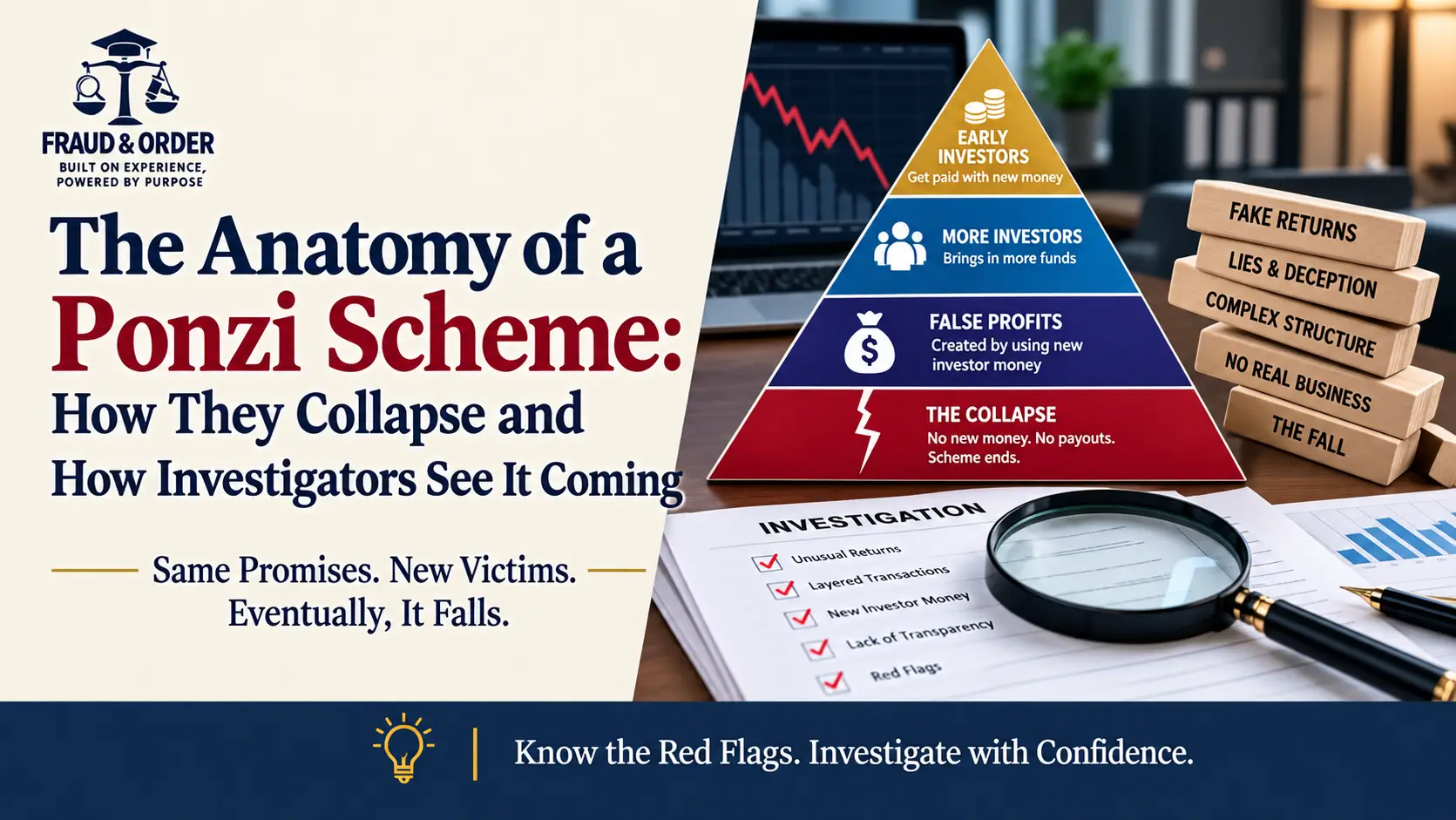
The mechanics are deceptively simple:
- An operator promises high returns with unusually low risk.
- Early investors are paid “returns” drawn from later investors’ deposits.
- Those early payouts generate word-of-mouth credibility, attracting more money.
- In many cases, the operator never invests the funds at all, diverting a portion for personal use.
Because no genuine earnings exist, the entire structure depends on a constant inflow of fresh capital. As one forensic accountant put it, if an operation cannot sustain itself without recruiting new money, it is not a business. It is a scheme.
Why Every Ponzi Scheme Eventually Collapses
Collapse is not a risk in a Ponzi scheme. It is a certainty. The only variable is timing.
A Ponzi scheme survives only while new money flows in faster than existing investors withdraw. That equation eventually breaks, usually in one of two ways. Either recruitment slows and there is not enough new cash to cover promised payouts, or too many existing investors try to cash out at once and the operator cannot meet redemptions.
Operators delay the inevitable with familiar tactics: encouraging investors to roll over their “profits” instead of withdrawing, and offering even higher returns to those looking to exit so they stay in. These maneuvers extend the lifespan but never change the outcome. Charles Ponzi’s own scheme unraveled when a newspaper investigated his impossible returns and a wave of investors demanded their money. Bernie Madoff’s collapsed during the 2008 financial crisis, when redemptions overwhelmed the incoming cash. The pattern is timeless. Only the packaging changes, from stamps to CDs to today’s crypto “high-yield” programs.
The Red Flags Investigators Watch For
Investigators and forensic accountants do not wait for the collapse. They read the warning signs, and the SEC has distilled the most reliable ones. A Ponzi scheme frequently shows several of these at once.
- Guaranteed high returns with little or no risk. Every real investment carries risk. A promise otherwise is the classic tell.
- Overly consistent returns. Legitimate investments fluctuate with the market. Suspiciously steady gains across all conditions defy reality.
- Unregistered investments and unlicensed sellers. Schemes often avoid registration with the SEC or state regulators, and sellers frequently lack proper licenses.
- Secretive or overly complex strategies. If the operator cannot clearly explain how the money makes money, that opacity is deliberate.
- Paperwork problems. Account statement errors, missing documentation, or vague records are common.
- Difficulty getting paid. Investors who struggle to withdraw, or who are pushed to roll over returns, are seeing the machine run dry.
The famous Madoff case is the textbook example. Analyst Harry Markopolos, now a forensic accountant, flagged that Madoff’s returns were far too consistent and defied the market he claimed to trade in. He compiled dozens of red flags years before the collapse. The lesson for organizations is that a single red flag rarely proves fraud, but a cluster of them provides strong predication to launch an investigation.
How Forensic Accountants Detect and Unwind a Scheme
Once suspicion is raised, forensic accountants confirm a Ponzi scheme by following the money. Their core techniques include transaction tracing, financial statement analysis, and reconstructing the flow of funds to reveal that payouts to old investors are simply new investors’ deposits recycled.
Key signals they look for include:
- A mismatch between claimed investment performance and actual market behavior
- Deviations from standard accounting principles in reported financials
- A near-total absence of segregation of duties, where one person controls funds, records, and reporting
- Reliance on an obscure, non-independent, or undersized auditor, a hallmark of the Madoff operation
That last point matters for every business, not just investment funds. Forensic accountants consistently rank weak segregation of duties as the number-one fraud risk factor, and the ACFE finds that more than half of occupational frauds trace back to weak or overridden internal controls. The same control weaknesses that enable a Ponzi scheme enable internal fraud, a connection we explore in our guide to the fraud triangle and why trusted staff steal. To see how professionals reconstruct the trail, our overview of what happens during a forensic accounting investigation walks through the process step by step.
Protecting Yourself and Your Organization
You do not need to be a forensic accountant to reduce your exposure to a Ponzi scheme. A handful of disciplined habits go a long way.
- Verify before you invest. Use free tools like FINRA BrokerCheck for brokers, the SEC’s adviserinfo.sec.gov for advisers, and EDGAR for filings. Unlicensed sellers and unregistered products are major warning signs.
- Distrust guaranteed returns. Treat any “consistent, risk-free, above-market” pitch as a red flag, not an opportunity.
- Demand transparency. If you cannot get clear documentation or a straightforward explanation of the strategy, walk away.
- Report suspicions early. A Ponzi scheme can be stopped before collapse. The SEC’s whistleblower program even offers awards for tips that lead to significant enforcement action.
- Strengthen internal controls. For organizations handling investor or client funds, enforce segregation of duties and independent audits so no single person can both run the money and report on it.
Don’t Wait for the Collapse
The tragedy of a Ponzi scheme is that the warning signs are almost always visible before the fall, if someone knows where to look. Consistent returns that defy the market, opacity, redemption trouble, and concentrated control are not mysteries. They are predication for action. The organizations and investors who stay protected are the ones who verify early and act on their instincts rather than their hopes.
If you suspect an investment fraud or Ponzi scheme, or need experienced eyes to trace where the money really went, do not go it alone. The team at Fraud & Order brings decades of experience uncovering financial crime and building documentation that stands up with regulators, boards, and courts. Reach out through the confidential intake at https://fraudorder.co/ to protect yourself and your organization with clarity and integrity.
Frequently Asked Questions
What is a Ponzi scheme?
A Ponzi scheme is an investment fraud that pays existing investors with money from new investors rather than from genuine profits. Because there is little or no real earning activity, it depends on a constant flow of new money and eventually collapses.
How is a Ponzi scheme different from a pyramid scheme?
In a Ponzi scheme, a central operator collects funds and pays “returns” from new deposits. A pyramid scheme requires participants to recruit others directly and earn from those recruits. Both rely on endless new participants and both are unsustainable by design.
Why does every Ponzi scheme eventually collapse?
Because it has no real earnings, it survives only while new money exceeds withdrawals. When recruitment slows or too many investors cash out at once, the operator cannot meet payouts and the scheme falls apart.
What are the biggest warning signs of a Ponzi scheme?
Guaranteed high returns with little or no risk, suspiciously consistent gains, unregistered investments, unlicensed sellers, secretive strategies, paperwork problems, and difficulty withdrawing funds. Several of these appearing together is a strong signal to investigate.
Can I get my money back if I invest in a Ponzi scheme?
Sometimes, partly. When a scheme collapses, a court-appointed receiver or bankruptcy trustee traces and distributes recovered assets, but recovery rates are often low, especially in crypto-based schemes where funds move offshore quickly. Acting early improves the odds.
How do investigators prove a Ponzi scheme exists?
Forensic accountants trace transactions and reconstruct the flow of funds to show that payouts to earlier investors came from later investors’ deposits, not real returns. They also flag inconsistencies with market performance, accounting standards, and independent verification.
References
U.S. Securities and Exchange Commission. (2024). Ponzi Schemes. https://www.investor.gov/protect-your-investments/fraud/types-fraud/ponzi-scheme
U.S. Securities and Exchange Commission. (2025). SEC Enforcement Results. https://www.sec.gov/newsroom/press-releases
Federal Bureau of Investigation. (2024). Common Fraud Schemes: Ponzi Schemes. https://www.fbi.gov/how-we-can-help-you/scams-and-safety/common-frauds-and-scams
U.S. Department of Justice. (2025). Fraud Section: Criminal Division. https://www.justice.gov/criminal/criminal-fraud
Association of Certified Fraud Examiners. (2024). Occupational Fraud 2024: A Report to the Nations. https://www.acfe.com/-/media/files/acfe/pdfs/rttn/2024/2024-report-to-the-nations.pdf
Financial Industry Regulatory Authority. (2024). BrokerCheck. https://brokercheck.finra.org/
American Bankruptcy Institute. (2025). Ponzi Scheme Roundup. https://www.abi.org/newsroom/ponzi-scheme-roundup
AICPA & CIMA. (2024). Forensic and Valuation Services. https://www.aicpa-cima.com/topic/forensic-valuation-services
Disclaimer
This article is provided for informational and educational purposes only and does not constitute legal, financial, or professional advice. Reading it does not create any attorney-client, accountant-client, or investigator-client relationship. Every situation is unique, so consult a qualified attorney, forensic accountant, or certified fraud examiner before acting on your specific circumstances. For questions about FraudOrder services, visit https://fraudorder.co/