
You have discovered something troubling in your finances, you have decided to act, and now one question keeps you up at night: how long is this going to take? It is the question almost every business owner asks first, and the honest answer surprises people. A fraud investigation is not a single dramatic event. It is a disciplined, phased process, and understanding the fraud investigation timeline week by week turns a frightening unknown into a manageable plan.
The stakes make that clarity worth having. According to the Association of Certified Fraud Examiners’ 2026 Report to the Nations, the typical fraud scheme runs about 12 months before it is caught, with a median loss of $104,000 per case, and every month a scheme hides costs an organization an estimated $9,400. Speed and structure both matter. Most moderately complex cases resolve within two to six months, though simple reviews can wrap in weeks and major multi-entity matters can exceed a year. Here is what the fraud investigation timeline actually looks like as it unfolds, week by week.
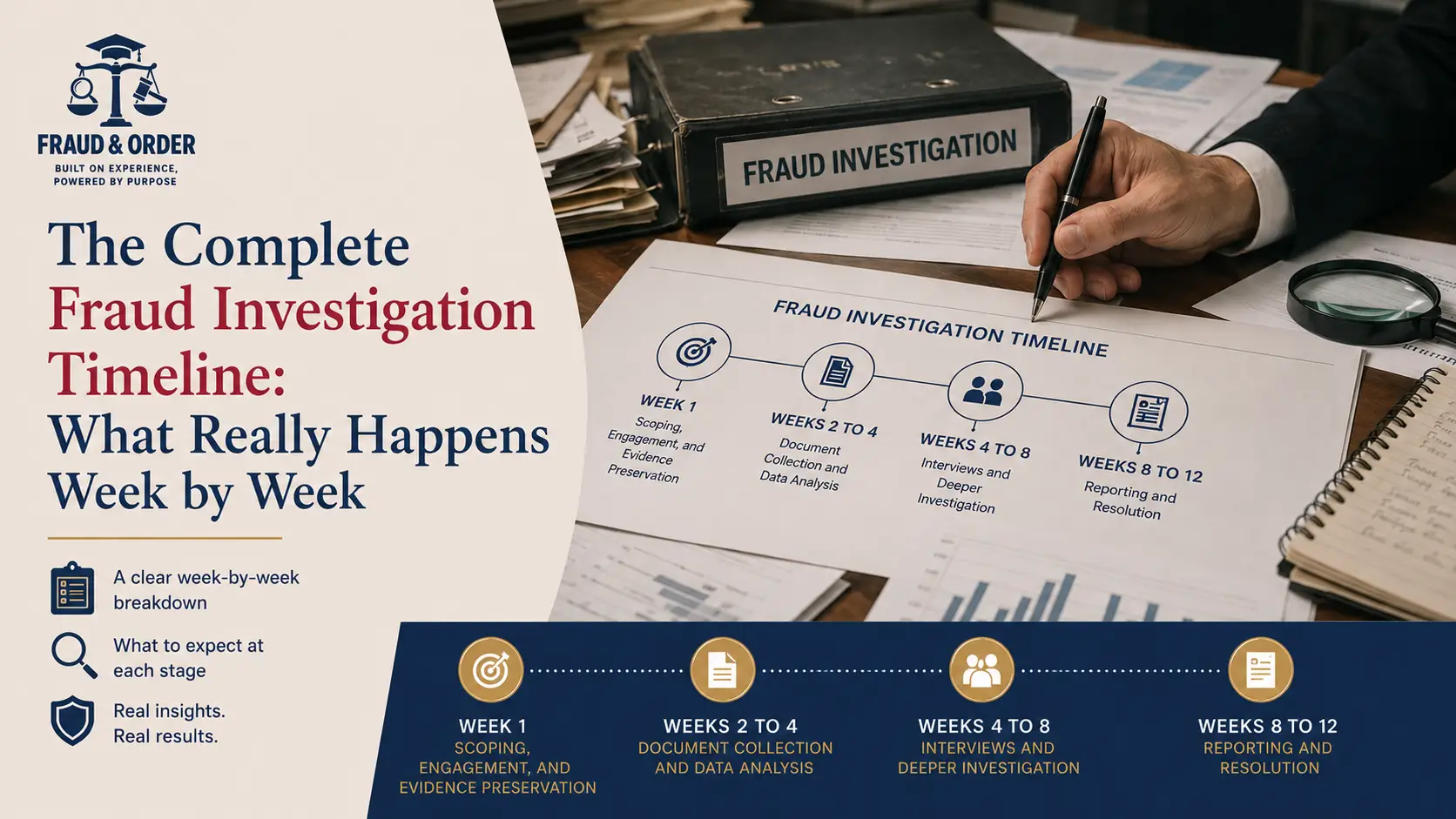
Week 1: Scoping, Engagement, and Evidence Preservation
The first week sets the tone for everything that follows, and it is the most time-sensitive stretch of the entire fraud investigation timeline. The priority is not accusation. It is preservation.
In these early days, investigators define the scope, agree on terms, and move quickly to secure evidence before it can disappear.
- Define the questions: who and what is under review, across which accounts and time periods.
- Agree on engagement scope, budget, and an approach memorandum that will be updated weekly.
- Preserve and image accounting systems, email, and devices so nothing is deleted or altered.
- Lock down access quietly, without confronting or alerting any suspect.
This preservation-first approach is the single most important part of the process. The moment a suspect senses scrutiny, records vanish, and gaps in disclosure become their own problem. If you have not yet reached this stage, our guide on what happens in the first call with a fraud investigator walks through how it begins.
Weeks 2 to 4: Document Collection and Data Analysis
With evidence secured, the investigation moves into its most labor-intensive phase. This is where the financial detective work happens, and it usually occupies several weeks of the fraud investigation timeline.
Investigators gather and organize the full record, then begin testing it for the fingerprints of fraud.
- Collect financial statements, ledgers, bank records, wire transfers, and system logs.
- Reconstruct incomplete or manipulated records into a clear, documented timeline.
- Apply analytical techniques such as trend analysis, ratio analysis, and data analytics.
- Trace the flow of funds through accounts, entities, and any shell structures.
The biggest variable here is how fast complete documentation becomes available. Late or incomplete disclosure is the leading cause of delay and cost overruns, which is why organized records shorten the timeline dramatically. To understand what this expertise covers, see our overview of what a forensic accountant is and when you need one.
Weeks 4 to 8: Interviews and Deeper Investigation
Once the financial data reveals patterns, the human element enters the fraud investigation timeline. Numbers tell investigators what happened; interviews help establish who and why.
This phase builds on the documented evidence rather than replacing it.
- Interview employees with account access, oversight responsibility, and relevant vendors.
- Test the consistency of documented evidence against what people describe.
- Follow new leads that surface during questioning.
- In some cases, conduct careful interviews with the individuals under suspicion.
Timing and sequence matter enormously here. Interviews conducted before the evidence is solid can tip off a suspect or contaminate the record, which is why they come after analysis, not before. Everything gathered is documented to preserve a clean chain of custody.
Weeks 8 to 12: Reporting and Resolution
The final phase converts weeks of work into something you can actually use. A quiet suspicion becomes a documented, defensible package, marking the culmination of the fraud investigation timeline.
Reporting typically moves through a draft and then a final version.
- Produce a draft report summarizing findings, methods, and quantified losses.
- Refine it into a final report built to withstand legal scrutiny and cross-examination.
- Present clear recommendations: law enforcement referral, insurance claim, civil recovery, or internal action.
- Support post-report steps, including expert testimony if the matter reaches court.
This is the payoff. A well-built report is what transforms your case into something insurers will pay on and prosecutors can act on. Before deciding on legal routing, it helps to understand when to hire a forensic accountant versus calling the police first and how the sequence protects your case.
What Makes a Timeline Faster or Slower
No two investigations move at exactly the same pace, but the drivers of speed are predictable. Knowing them helps you set realistic expectations and actively shorten your own fraud investigation timeline. A well-managed fraud investigation timeline is as much about your preparation as the investigator’s skill.
Several factors push cases longer or shorter:
- Documentation quality. Organized, complete records are the single biggest accelerator.
- Case complexity. Multiple entities, jurisdictions, or years of activity add time.
- Scheme duration. Longer-running frauds leave more to reconstruct.
- Cooperation. Prompt access to systems and people keeps momentum.
- Scope discipline. A focused mandate resolves faster than an open-ended hunt.
The lesson is empowering: much of what determines speed is within your control. Clean records and quick cooperation can compress months into weeks. For a sense of how these variables affect budget, our 2026 fraud investigation cost guide connects timeline to cost.
Turn Uncertainty Into a Plan
The fraud investigation timeline is not a mystery once you see its structure: preserve in week one, collect and analyze through the first month, interview as patterns emerge, then report and resolve. Understanding the sequence replaces dread with a clear sense of what comes next and why each step matters.
If you suspect fraud in your organization, the worst move is to wait or to start “cleaning up” the books yourself. Preserve what you have, avoid confronting anyone, and get expert guidance early. Reach out to the FraudOrder team for a confidential conversation about your situation and the right next step. Truth, muscle, and justice start with understanding the process.
Frequently Asked Questions
How long does a fraud investigation take from start to finish?
It varies with complexity. Simple financial reviews can finish in two to four weeks, moderately complex fraud cases typically run two to six months, and major multi-entity investigations can exceed a year. The single biggest factor is how quickly complete documentation becomes available.
What is the very first step in a fraud investigation?
Preservation, not accusation. Before anyone is confronted, investigators secure and image financial systems, email, and devices so evidence cannot be deleted or altered. Scoping the investigation and agreeing on terms happen alongside this, but protecting the evidence comes first.
Why does the investigation take weeks instead of days?
Building a defensible case requires collecting complete records, reconstructing manipulated ones, tracing funds, and testing findings against interviews. Rushing these steps produces weak evidence that will not hold up legally. The thoroughness is what makes the final report usable for recovery or prosecution.
Can I speed up the process?
Yes, more than most people expect. Organized, complete documentation is the biggest accelerator, since late or incomplete disclosure is the leading cause of delay. Cooperating quickly, keeping the scope focused, and preserving records early can compress the timeline significantly.
When are the suspected individuals interviewed?
Usually after the financial analysis, not before. Interviewing too early can alert a suspect and contaminate evidence. By the time interviews happen, investigators have documented patterns to test against what people say, which makes the conversations far more productive.
What do I actually receive at the end?
You receive a final report that documents the findings, methodology, and quantified losses in a form built to withstand legal scrutiny. It includes clear recommendations, whether that means a law enforcement referral, an insurance claim, civil recovery, or internal action, plus support if the matter goes to court.
References
- Association of Certified Fraud Examiners. (2026). Occupational Fraud 2026: A Report to the Nations. https://www.acfe.com/acfe-insights-blog/blog-detail?s=key-findings-report-to-the-nations-2026
- Association of Certified Fraud Examiners. (2025). The Power of Forensic Accountants in Uncovering Fraud. https://www.acfe.com/acfe-insights-blog/blog-detail?s=the-power-of-forensic-accountants
- Federal Bureau of Investigation. (2025). White-Collar Crime. https://www.fbi.gov/investigate/white-collar-crime
- U.S. Department of Justice. (2025). Criminal Division Fraud Section. https://www.justice.gov/criminal/criminal-fraud
- American Institute of CPAs. (2025). Forensic and Valuation Services. https://www.aicpa-cima.com/topic/forensic-valuation-services
- Institute of Internal Auditors. (2025). Fraud and Internal Audit Guidance. https://www.theiia.org/en/content/guidance/
- ACCA. (2025). Forensic Auditing. https://www.accaglobal.com/us/en/student/exam-support-resources/professional-exams-study-resources/p7/technical-articles/forensic-accounting.html
- Federal Trade Commission. (2025). Consumer Sentinel Network Data Book. https://www.ftc.gov/reports/consumer-sentinel-network-data-book-2024
Disclaimer: This article is for informational purposes only and does not constitute legal, financial, or professional advice, and no client relationship is created by reading it. Every situation is different, so consult qualified legal counsel, forensic accountants, or licensed investigators about your specific circumstances. For questions about FraudOrder services, visit https://fraudorder.co