
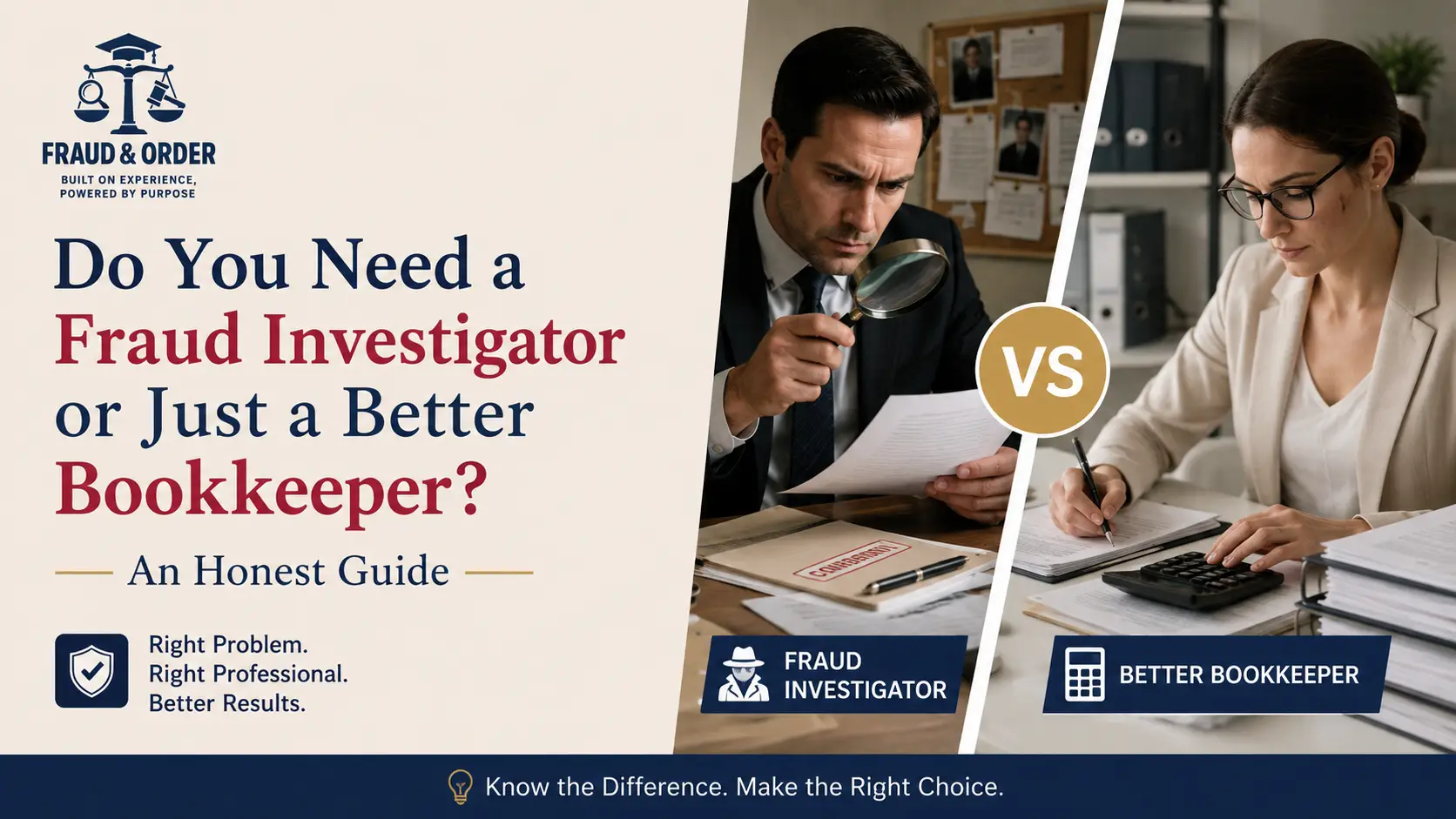
Your books are a mess. Numbers do not reconcile, an account looks off, and a knot forms in your stomach. Is someone stealing from you, or is your bookkeeping simply sloppy? It is one of the most common and consequential questions a business owner faces, and the honest answer is that the two problems look almost identical from the outside. Knowing whether you need a fraud investigator or just a better bookkeeper can save you both a fortune and a false accusation.
The stakes are not abstract. According to the Association of Certified Fraud Examiners’ 2026 Report to the Nations, organizations lose roughly 5 percent of annual revenue to fraud each year, with a median loss of $104,000 per case. The typical scheme runs about 12 months before anyone catches it, and every month it hides costs an organization an estimated $9,400 on average. That is why telling disorganization apart from deception matters so much. This guide will help you decide whether you need a fraud investigator or a bookkeeper, without jumping to the wrong conclusion.
First, Understand What Each One Actually Does
These roles solve fundamentally different problems, and confusing them is where costly mistakes begin. Deciding between a fraud investigator or a bookkeeper starts with knowing what each one is actually for.
A bookkeeper keeps your financial records accurate and current. They record transactions, reconcile accounts, manage invoices, and produce the reports you rely on to run the business. A good one prevents errors and keeps your finances clean and organized. Their work is about accuracy and order.
A fraud investigator, often a forensic accountant, does something different. They examine specific suspicious activity to determine whether someone intentionally stole or deceived, then build evidence that holds up in court. Where a bookkeeper assumes honest mistakes, a fraud investigator is trained to detect deliberate concealment. Understanding what a forensic specialist does is the first step, and our guide on what a forensic accountant is and when you need one breaks it down in plain terms.
The Case for Just a Better Bookkeeper
Let us be honest: many financial messes are not fraud at all. They are the predictable result of overwhelmed staff, outdated systems, or simple human error. Before you assume the worst, consider whether the problem points to disorganization rather than deception.
You probably need a better bookkeeper, not a fraud investigator, when the signs point to disorganization. In the fraud investigator or a bookkeeper decision, these clues push clearly toward the bookkeeper:
- Discrepancies are random and inconsistent, not patterned or one-directional.
- Records are simply behind, incomplete, or poorly categorized.
- Errors appear across many people and accounts, with no single beneficiary.
- The person responsible readily explains mistakes and welcomes review.
- You have never established clear processes or reconciliation routines.
In these cases, the fix is better systems and skilled help, not an investigation. Upgrading your bookkeeping, adding oversight, and tightening routines will often resolve the problem entirely, and cost you far less than a forensic engagement.
The Warning Signs You Need a Fraud Investigator
Sometimes the mess is not innocent. Certain patterns point away from sloppiness and toward intent, and recognizing them early is critical. When you notice these red flags, the fraud investigator or a bookkeeper question tips toward the investigator.
Watch for signals like these:
- Discrepancies consistently favor one person or flow in one direction.
- An employee is defensive about oversight, refuses to share records, or never takes a vacation.
- Missing documentation clusters around specific transactions or vendors.
- Someone’s lifestyle suddenly outpaces their known income.
- Vendors you cannot verify, or payments to addresses that match an employee’s.
- The same person controls a process end to end, with no one reviewing their work.
That last point matters more than any other. The ACFE consistently finds that a lack of internal controls and management override drive the majority of fraud cases. When one person owns the whole process unchecked, the risk climbs sharply. If several of these signs sound familiar, our guide on what happens in the first call with a fraud investigator explains what a confidential next step looks like.
When It Is Both: The Order That Protects You
Here is the nuance most guides miss. Often the fraud investigator or a bookkeeper answer is not either/or but both, and the sequence is everything. If you genuinely suspect intentional theft, do not simply hand the problem to a new bookkeeper and ask them to “clean it up.” That well-meaning cleanup can overwrite the very evidence a fraud investigator would need.
When fraud is a real possibility, the protective order looks like this:
- Preserve first. Avoid altering records or confronting anyone before evidence is secured.
- Bring in investigation expertise to determine whether fraud occurred and quantify it.
- Then rebuild your bookkeeping and controls on a clean, documented foundation.
Getting this backwards is a costly mistake. A fraud investigator preserves and analyzes evidence before it can vanish, while a bookkeeper’s job is to normalize records, which can inadvertently destroy proof. Decide which risk you are facing before anyone starts “fixing” the books. For a realistic sense of what professional investigation involves, our 2026 fraud investigation cost guide lays out the variables.
Practical Steps You Can Take Right Now
You do not need to be certain of fraud to act wisely today. A few steps protect you whether the answer turns out to be a fraud investigator or a bookkeeper.
- Document what you have noticed, with dates and specifics, and keep it private.
- Resist the urge to confront anyone before you understand what you are dealing with.
- Quietly restrict access to sensitive financial systems where you reasonably can.
- Separate duties so no single person controls a financial process end to end.
- Establish an anonymous reporting channel, since tips remain the top way fraud is caught.
These moves cost little and lose you nothing if the problem turns out to be innocent. They simply preserve your options.
Get an Honest Answer Before You Act
So, do you need a fraud investigator or just a better bookkeeper? The truthful answer is that you need clarity first. Random, explainable errors usually point to bookkeeping. Patterned, one-sided, concealed discrepancies point to something worse. And when there is real doubt, preserving evidence before “cleaning up” the books is what protects your recovery and your reputation alike.
You do not have to make that call alone or risk a false accusation. If your instinct says something is wrong, reach out to the FraudOrder team for a confidential conversation about your situation. An honest assessment now beats an expensive assumption later. Truth, muscle, and justice start with asking the right question first.
Frequently Asked Questions
How can I tell if my financial problems are fraud or just bad bookkeeping?
Look at the pattern. Innocent errors tend to be random, inconsistent, and explainable, spread across people and accounts. Fraud tends to be patterned, one-directional, and concealed, often favoring a single person. When discrepancies consistently benefit one individual or someone resists oversight, that leans toward fraud.
Can a bookkeeper detect fraud?
Sometimes a sharp bookkeeper spots irregularities, but detection is not their core function. Bookkeepers assume honest mistakes and work to correct them, while fraud investigators are trained to identify deliberate concealment and build legal evidence. A bookkeeper may raise the flag, but confirming fraud usually requires investigative expertise.
Should I just have my accountant clean up the books first?
Not if you genuinely suspect fraud. Cleaning up records before evidence is preserved can inadvertently destroy the proof you would need to recover losses or pursue a case. When intentional theft is a real possibility, preserve first and investigate before anyone normalizes the records.
Isn’t hiring a fraud investigator expensive and premature?
A confidential initial conversation is not the same as a full investigation. Discussing your situation with a professional helps you decide whether investigation is warranted at all, potentially saving you from both an expensive misstep and a false accusation. Early clarity is usually cheaper than prolonged uncertainty.
What if I accuse someone and I am wrong?
That risk is exactly why sequence matters. Confronting a suspected employee before you understand the facts can create defamation and wrongful-termination exposure. Documenting quietly, preserving evidence, and seeking an objective assessment first protects both you and the people involved.
How fast should I act if I suspect fraud?
Quickly, but carefully. Every month a scheme hides adds to the loss, yet rushing to confront someone can destroy evidence. The right approach is prompt, quiet action: document, restrict access, preserve records, and get an expert assessment before taking any public step.
References
- Association of Certified Fraud Examiners. (2026). Occupational Fraud 2026: A Report to the Nations. https://www.acfe.com/acfe-insights-blog/blog-detail?s=key-findings-report-to-the-nations-2026
- Association of Certified Fraud Examiners. (2025). The Power of Forensic Accountants in Uncovering Fraud. https://www.acfe.com/acfe-insights-blog/blog-detail?s=the-power-of-forensic-accountants
- Federal Bureau of Investigation. (2025). White-Collar Crime. https://www.fbi.gov/investigate/white-collar-crime
- U.S. Department of Justice. (2025). Criminal Division Fraud Section. https://www.justice.gov/criminal/criminal-fraud
- American Institute of CPAs. (2025). Forensic and Valuation Services. https://www.aicpa-cima.com/topic/forensic-valuation-services
- Institute of Internal Auditors. (2025). Fraud and Internal Audit Guidance. https://www.theiia.org/en/content/guidance/
- Federal Trade Commission. (2025). Consumer Sentinel Network Data Book. https://www.ftc.gov/reports/consumer-sentinel-network-data-book-2024
- Small Business Administration. (2025). Protect Your Small Business From Fraud. https://www.sba.gov/
Disclaimer: This article is for informational purposes only and does not constitute legal, financial, or professional advice, and no client relationship is created by reading it. Every situation is different, so consult qualified legal counsel, forensic accountants, or licensed investigators about your specific circumstances. For questions about FraudOrder services, visit https://fraudorder.co/