
The person who steals from your company is rarely the one you would suspect. It is often the long-tenured bookkeeper, the reliable manager, the employee everyone trusts. That is the unsettling insight behind the fraud triangle, a model that explains why ordinary, honest-seeming people cross the line. According to the Association of Certified Fraud Examiners (ACFE) 2024 Report to the Nations, the typical occupational fraud case causes a median loss of $145,000, drawn from more than 1,900 real cases across 138 countries. Even more telling, about 84% of fraudsters displayed at least one behavioral red flag before they were caught.
Understanding the fraud triangle gives business owners, compliance officers, and auditors a practical lens for spotting risk before it becomes loss. Let’s break down the three forces at work and, more importantly, how to disrupt them.
What Is the Fraud Triangle?
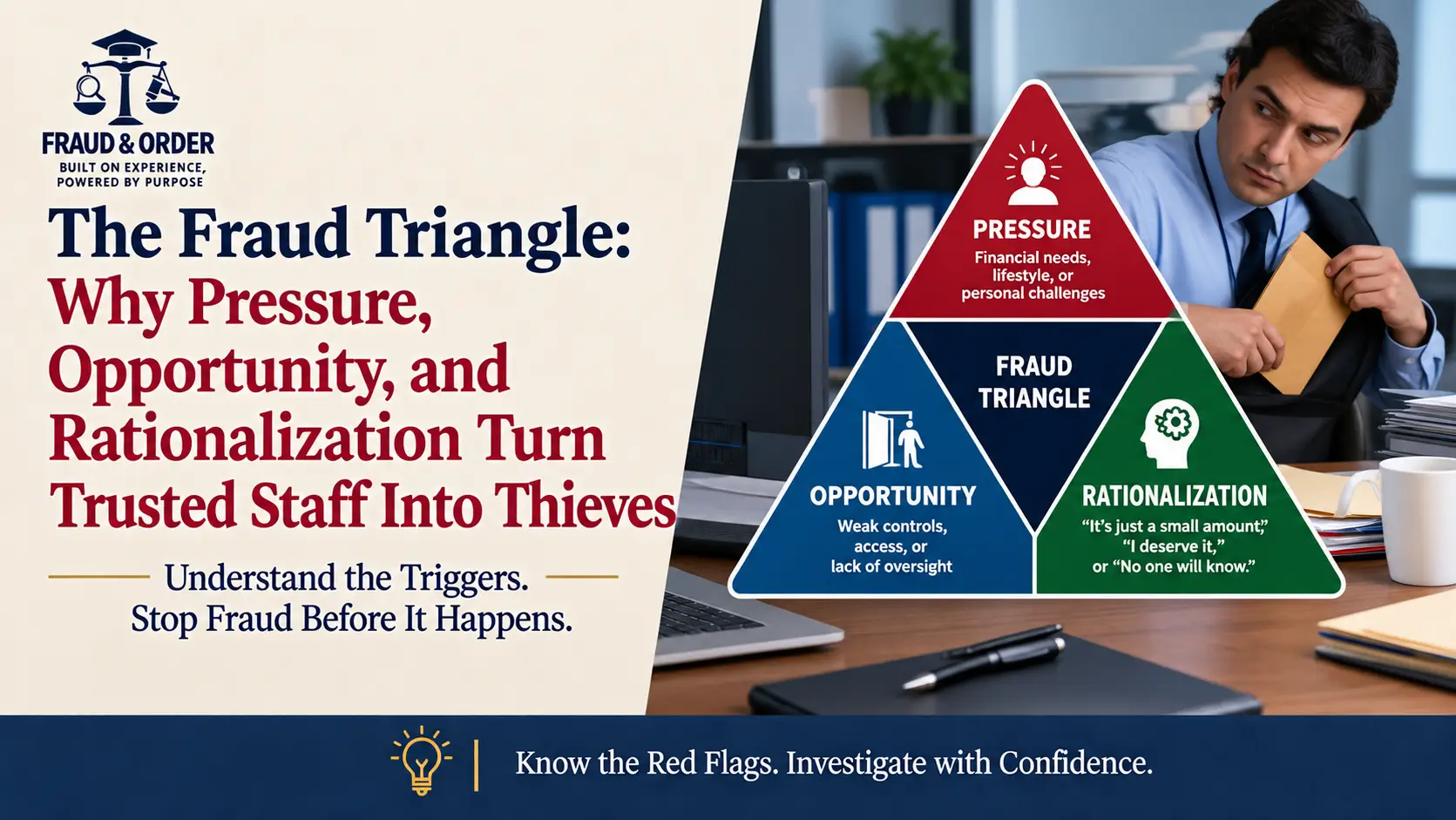
The fraud triangle is a framework developed by criminologist Donald Cressey in 1953 to explain why people commit occupational fraud. It holds that three conditions typically converge before an otherwise trustworthy employee steals: pressure, opportunity, and rationalization.
Think of it as three sides that must meet. Remove any one side and the triangle collapses, which is precisely why the model is so useful. Decades later, it remains the dominant analytical tool for fraud examiners, internal auditors, and compliance professionals, because it maps neatly onto the real behavioral and control weaknesses that precede fraud.
Each side represents a distinct force. Two of them live inside the person. One of them lives inside your organization, and that is the one you can control most directly.
Pressure: The Motive Behind the Theft
Pressure is the perceived financial or emotional strain that pushes someone toward fraud. It is usually a problem the person feels they cannot share, a “non-shareable” burden in Cressey’s original language.
Common sources of pressure include:
- Personal financial trouble, debt, or living beyond one’s means
- Addiction, whether gambling, substances, or other costly habits
- Medical bills or a family emergency
- Workplace pressure such as fear of job loss, denied promotions, or aggressive performance targets
The data backs this up. Living beyond one’s means is the single most common behavioral red flag, appearing in roughly 39% of cases and topping the list in every ACFE study since 2008. Financial difficulties rank a close second. When an employee’s lifestyle suddenly outpaces their salary, or when creditors start calling the office, pressure is often building.
You cannot eliminate every employee’s personal hardship, but you can watch for the warning signs and foster a culture where people feel able to ask for help before they act on desperation.
Opportunity: The Open Door You Can Close
Opportunity is the gap in your controls that lets fraud happen without detection. Of the three sides of the fraud triangle, this is the one your organization has the most power over, which makes it the smartest place to focus.
Opportunity flourishes when one person controls too much of a process. If the same individual can request a purchase, approve it, record it, and reconcile the books, no independent check exists. The ACFE consistently finds that more than half of occupational fraud cases trace back to weak internal controls or the override of existing ones.
You close the door by increasing both the actual and perceived likelihood of getting caught. Practical steps include:
- Segregation of duties. Ensure no single employee controls an entire financial cycle from start to finish.
- Mandatory vacations and job rotation. Schemes often unravel when the person running them steps away.
- Surprise audits. Unannounced reviews catch what predictable ones miss.
- Anonymous reporting channels. Tips are the number one way fraud is caught, responsible for about 43% of detections, more than three times the next most common method.
We explore how these gaps play out in specific settings in our guides to catching payroll fraud and ghost employees and to procurement fraud, rigged bids, and kickbacks.
Rationalization: The Story They Tell Themselves
Rationalization is the internal justification that lets a person reconcile theft with their self-image as an honest individual. Most fraudsters do not see themselves as criminals, so they build a story that makes the act feel acceptable.
Common rationalizations sound like:
- “It’s just a loan. I’ll pay it back.”
- “The company wastes money anyway. No one will miss it.”
- “I deserve this after years of being underpaid and overlooked.”
- “Everyone does it. It’s basically expected.”
Rationalization thrives where ethical boundaries are unclear, inconsistently enforced, or undermined by leadership. When employees see rules bent at the top or misconduct going unpunished, the internal justifications become far easier to sustain.
You weaken this side of the fraud triangle by making integrity visible and consistent. A clear code of conduct, ethics training, leadership that models the standard, and consistent consequences for violations all make rationalization harder to hold onto.
How to Break the Fraud Triangle in Your Organization
The beauty of the fraud triangle is that you only need to disrupt one side to prevent the scheme. In practice, strong programs address all three. Here is how to put it to work immediately:
- Watch for pressure signals. Train managers to notice sudden lifestyle changes, financial stress, and behavioral shifts, without jumping to accusations.
- Attack opportunity first. It is the side you control. Enforce segregation of duties, run surprise audits, and require vacations for staff in sensitive roles.
- Undermine rationalization. Build a visible ethics culture, train employees on reporting, and apply consequences consistently at every level.
- Give people a way to speak up. An anonymous hotline is one of the most cost-effective anti-fraud investments available, given how many cases tips uncover.
When you notice several red flags clustering around one person, especially signals that map to different sides of the triangle, take it seriously. Someone living beyond their means who also controls an unmonitored billing cycle is a textbook risk. If you suspect an active scheme, our step-by-step overview of what happens during a forensic accounting investigation explains how professionals handle it without destroying evidence.
Turn Awareness Into Protection
The fraud triangle endures because it reflects a hard truth: given enough pressure, a plausible justification, and an open door, even trusted staff can rationalize theft. The organizations that stay protected are the ones that treat the triangle as a living risk tool, not an academic idea, and design their controls and culture to collapse it.
If you are seeing warning signs and want experienced eyes on the situation, do not wait for the loss to grow. The team at Fraud & Order brings decades of experience uncovering financial crime and building documentation that stands up to scrutiny. Reach out through the confidential intake at https://fraudorder.co/ to protect your organization with integrity and clarity.
Frequently Asked Questions
What is the fraud triangle?
The fraud triangle is a model developed by criminologist Donald Cressey in 1953 that explains why people commit occupational fraud. It identifies three converging conditions: pressure, opportunity, and rationalization. When all three are present, an otherwise honest employee becomes far more likely to steal.
Which side of the fraud triangle can businesses control most?
Opportunity. Pressure and rationalization live inside the individual, but opportunity is created by weak internal controls, which your organization designs and enforces. Strengthening controls is the most direct way to reduce fraud risk.
What are the most common signs of pressure?
Living beyond one’s means is the top behavioral red flag, appearing in about 39% of cases, followed by financial difficulties. Sudden lifestyle changes, gambling or addiction, and workplace stress such as fear of job loss are also frequent indicators.
How does rationalization work?
Rationalization is the story a fraudster tells themselves to justify theft while still seeing themselves as honest. Common examples include treating stolen funds as a loan or feeling entitled after years of perceived underpayment. A strong ethics culture makes these justifications harder to sustain.
What is the best way to detect fraud early?
Tips are the number one detection method, uncovering about 43% of cases in the ACFE’s 2024 study, more than three times any other. An anonymous reporting hotline, paired with surprise audits and segregation of duties, gives you the strongest early-warning system.
When should we bring in a professional investigator?
As soon as you have credible evidence of a scheme, and before confronting anyone. A qualified fraud examiner or forensic accountant preserves evidence and quantifies losses properly, protecting your options for recovery and legal action.
References
Association of Certified Fraud Examiners. (2024). Occupational Fraud 2024: A Report to the Nations. https://www.acfe.com/-/media/files/acfe/pdfs/rttn/2024/2024-report-to-the-nations.pdf
Federal Bureau of Investigation. (2024). White-Collar Crime. https://www.fbi.gov/investigate/white-collar-crime
U.S. Department of Justice. (2025). Fraud Section: Criminal Division. https://www.justice.gov/criminal/criminal-fraud
Institute of Internal Auditors. (2025). Fraud Prevention and Detection. https://www.theiia.org/en/content/articles/global-knowledge-brief/2023/fraud-and-internal-audit/
AICPA & CIMA. (2024). AU-C Section 240: Consideration of Fraud in a Financial Statement Audit. https://www.aicpa-cima.com/resources/download/consideration-of-fraud-in-a-financial-statement-audit
Office of the New York State Comptroller. (2024). Red Flags for Fraud. https://www.osc.ny.gov/files/local-government/publications/pdf/red_flags_fraud.pdf
U.S. Government Accountability Office. (2024). Fraud Risk Management. https://www.gao.gov/fraud-risk-management
EBSCO Research Starters. (2025). Fraud Triangle. https://www.ebsco.com/research-starters/law/fraud-triangle
Disclaimer
This article is provided for informational and educational purposes only and does not constitute legal, financial, or professional advice. Reading it does not create any attorney-client, accountant-client, or investigator-client relationship. Every situation is unique, so consult a qualified attorney, forensic accountant, or certified fraud examiner before acting on your specific circumstances. For questions about FraudOrder services, visit https://fraudorder.co/