
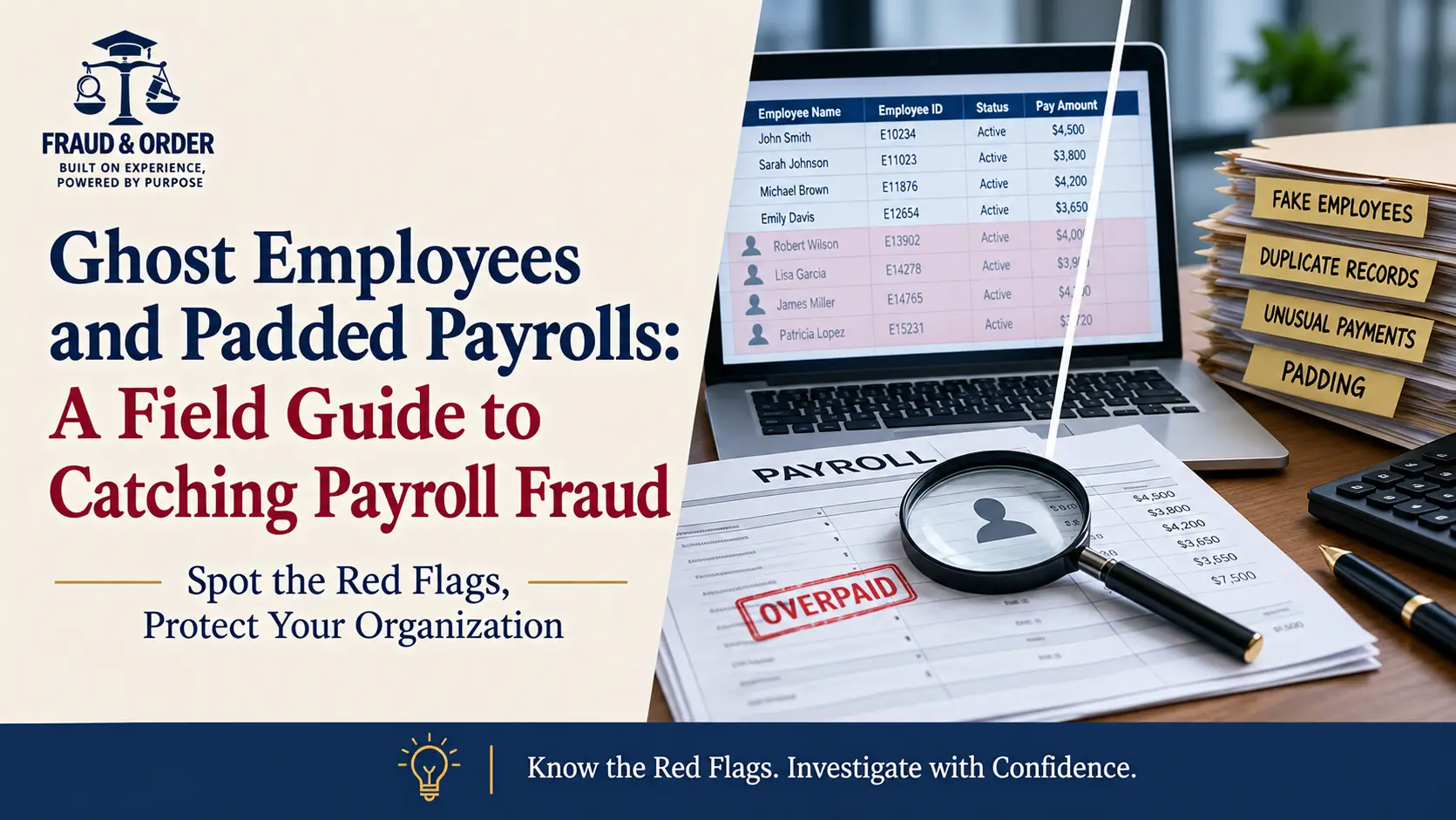
Payroll is the one system almost nobody double-checks. It runs on schedule, the numbers look familiar, and the money moves before anyone asks questions. That trust is exactly what makes it a target. According to the Association of Certified Fraud Examiners (ACFE) 2024 Report to the Nations, payroll schemes appeared in roughly 10% of the more than 1,900 occupational fraud cases studied, carried a median loss of $50,000, and ran for about 18 months before anyone noticed. Eighteen months of quiet, steady theft, hiding in plain sight inside a routine most organizations never scrutinize.
The good news is that payroll fraud detection is learnable. These schemes follow patterns, leave data trails, and break down under the right controls. This field guide walks you through what to look for and what to do about it.
Why Payroll Is Such an Easy Target
Payroll sits at the intersection of high transaction volume, sensitive personal data, and limited oversight. Every cycle produces hundreds or thousands of individual payments, each one trusted and rarely examined line by line.
The ACFE found that more than half of all occupational fraud cases traced back to weak internal controls or the override of existing ones. In payroll, that usually means a single person can add an employee, change a pay rate, approve hours, and release payment with no independent check. When one individual controls the whole chain, the door is wide open.
Certain sectors feel this more acutely. Industries with high staff turnover and complex shift patterns, such as healthcare, retail, warehousing, and construction, give fraudsters more places to hide a fake name or padded shift. Anywhere records are messy, detection gets harder.
For a closer look at how these schemes actually operate, see our companion piece on how employees steal through fake timesheets and ghost workers.
The Four Schemes You Need to Recognize
Effective payroll fraud detection starts with knowing what you are hunting for. Most schemes fall into four families.
- Ghost employees. A fake or terminated worker stays on the payroll, and the fraudster collects their pay. The “ghost” may be entirely fictional or a real former employee whose record was never deactivated.
- Padded hours and buddy punching. Real employees inflate their worked time, or clock in for absent coworkers. Small amounts per cycle add up quietly over months.
- Commission and pay-rate manipulation. Someone quietly bumps a salary, adds an unearned bonus, or inflates commission figures without authorization.
- Falsified expenses and reimbursements. Fabricated or inflated expense claims flow through payroll or reimbursement channels with little verification.
The most costly cases often combine several of these, especially when the person committing them also controls the records that would expose them.
Red Flags That Deserve a Second Look
Payroll fraud rarely announces itself, but it does leave fingerprints. The ACFE reports that around 84% of fraudsters display at least one behavioral warning sign before being caught, with “living beyond their means” the single most common. Pair those human signals with the data anomalies below.
- Two or more employees sharing the same bank account, address, or tax ID
- Paychecks for employees with no tax withholding, no deductions, or no benefits enrollment
- A worker who is never on leave, never sick, and whose pay is never questioned
- Overtime that spikes for specific individuals without a matching workload
- Employees who resist direct deposit or insist on collecting physical checks
- A payroll administrator reluctant to take vacation or share duties
No single flag proves fraud. But clusters of them, especially around one person or one process, are worth investigating. The same instinct for reading warning signs applies across financial crime, as we cover in our guide to small business embezzlement risk.
A Practical Detection Playbook
You do not need a forensic team to start catching these schemes. You need routine, separation of duties, and a willingness to actually look. Here are steps you can implement immediately.
- Separate the duties. Make sure the person who adds employees is not the same person who approves hours or releases payment. This one change disrupts most single-actor schemes.
- Run a ghost-employee audit. Cross-check the active payroll list against HR records, badge or system access logs, and department head confirmations. Anyone who cannot be verified by a manager gets flagged.
- Match bank accounts and personal data. Sort payroll data for duplicate account numbers, addresses, phone numbers, and tax IDs. Duplicates are one of the clearest ghost-employee signals.
- Reconcile period over period. Compare each payroll run against the last. Investigate new names, pay-rate changes, and overtime jumps that lack documentation.
- Use surprise audits. Unannounced reviews catch what scheduled ones miss. The ACFE consistently links surprise audits and reporting hotlines to lower losses and faster detection.
- Build an anonymous reporting channel. Tips are the number one way fraud gets caught, responsible for about 43% of detections. A hotline is one of the highest-return controls available.
Data analytics tools can automate much of this, scanning entire payroll files for the duplicate accounts and statistical outliers that a manual review would miss. When a review surfaces something serious, our overview of what happens during a forensic accounting investigation explains the next steps.
When to Bring in a Professional
Internal controls catch a great deal, but some situations call for outside expertise. If you find evidence of an active scheme, suspect collusion, or believe losses are significant, stop and get help before you act. A mishandled internal confrontation can destroy evidence, tip off the fraudster, and undermine any future recovery or prosecution.
Professional fraud examiners and forensic accountants preserve evidence properly, quantify losses in a defensible way, and build documentation that holds up with regulators, boards, and courts. If recovery is your goal, moving carefully in the early hours matters enormously, as we explain in our guide to recovering money from an embezzling employee.
Frequently Asked Questions
What is a ghost employee?
A ghost employee is a name on the payroll that does not correspond to a real, currently working person. It may be a fictional identity or a former employee whose record was never removed. Someone with payroll access collects the pay issued to that name.
How common is payroll fraud?
Payroll schemes appeared in roughly 10% of occupational fraud cases in the ACFE’s 2024 study, and other analyses suggest payroll fraud touches a significant share of businesses over time. It is common enough that every organization paying employees should treat it as a real risk.
How long does payroll fraud usually go undetected?
The ACFE found payroll schemes run about 18 months on average before discovery. Longer duration means larger losses, which is why routine reconciliation and surprise audits matter so much.
What is the single best control against payroll fraud?
Separation of duties. When no one person can create an employee, approve hours, and release payment, most single-actor schemes fall apart. Pairing that with an anonymous reporting hotline covers the largest share of risk.
Can small businesses really afford fraud detection?
Yes. Many of the most effective controls, such as separating duties, reconciling payroll runs, and matching bank accounts, cost little beyond attention and discipline. Small businesses are hit harder by fraud, so these habits pay for themselves.
When should we involve law enforcement or an investigator?
Once you have credible evidence of theft, and before confronting the suspect, consult a qualified investigator or forensic accountant. They help preserve evidence and quantify losses so you keep your options for recovery and prosecution open.
Take Control of Your Payroll Before It Controls You
Payroll fraud thrives on inattention. The single most powerful step you can take is to start looking, with separated duties, regular reconciliation, and a channel for employees to speak up. Every month a scheme survives is money you will likely never recover, so early detection is not just good governance, it is loss prevention.
If you suspect ghost employees or padded payrolls in your organization, do not go it alone. The team at Fraud & Order brings decades of experience uncovering financial crime and building documentation that stands up to scrutiny. Reach out through the confidential intake at https://fraudorder.co/ to protect your organization with clarity and integrity.
References
Association of Certified Fraud Examiners. (2024). Occupational Fraud 2024: A Report to the Nations. https://www.acfe.com/-/media/files/acfe/pdfs/rttn/2024/2024-report-to-the-nations.pdf
Federal Bureau of Investigation. (2024). White-Collar Crime. https://www.fbi.gov/investigate/white-collar-crime
U.S. Department of Justice. (2025). Fraud Section: Criminal Division. https://www.justice.gov/criminal/criminal-fraud
Institute of Internal Auditors. (2025). Fraud and Internal Audit. https://www.theiia.org/en/content/articles/global-knowledge-brief/2023/fraud-and-internal-audit/
AICPA & CIMA. (2024). Forensic and Valuation Services. https://www.aicpa-cima.com/topic/forensic-valuation-services
U.S. Government Accountability Office. (2024). Fraud Risk Management. https://www.gao.gov/fraud-risk-management
Aprio. (2025). Common Asset Misappropriation Schemes. https://www.aprio.com/insights-events/what-are-the-most-common-asset-misappropriation-schemes-and-who-are-conducting-them-ins-article/
Brady Ware. (2025). How to Protect Your Business From Payroll Fraud Schemes. https://bradyware.com/how-to-protect-your-business-from-payroll-fraud-schemes/
Fraud.net. (2025). What Is Ghost Employee Fraud? Definition & Guide. https://www.fraud.net/glossary/ghost-employee-fraud
Disclaimer: This article is provided for informational and educational purposes only and does not constitute legal, financial, or professional advice. Reading it does not create any attorney-client, accountant-client, or investigator-client relationship. Every situation is unique, so consult a qualified attorney, forensic accountant, or certified fraud examiner before acting on your specific circumstances. For questions about FraudOrder services, visit https://fraudorder.co/