
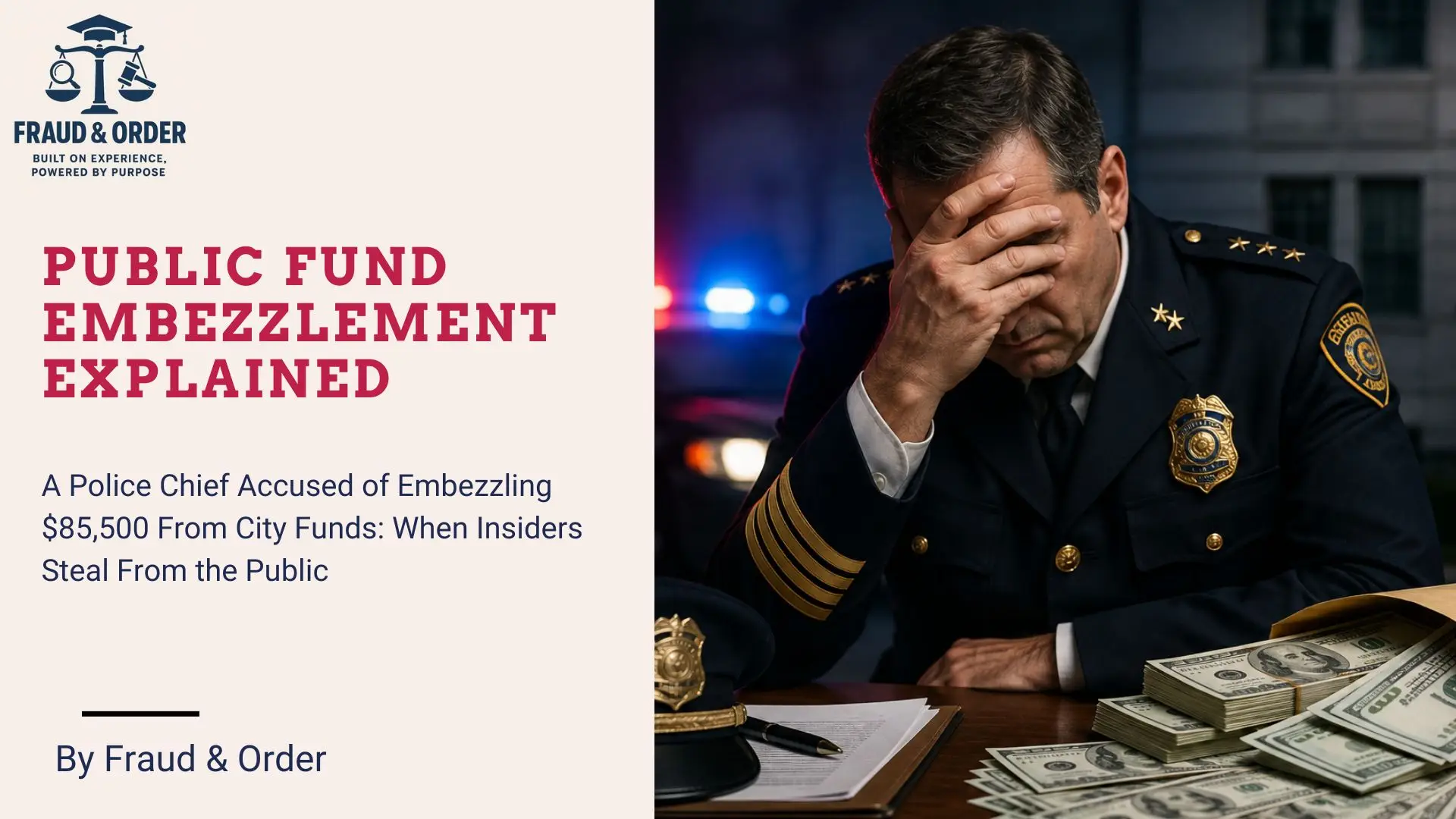
When the person entrusted to enforce the law is accused of breaking it, the damage runs deeper than the dollar figure. In early 2026, Connecticut prosecutors charged a former New Haven police chief with embezzling a reported $85,500 from two city funds, most of it from an account used to pay confidential informants. The defendant has pleaded not guilty, and the allegations remain unproven in court. But the case is a textbook example of a problem every organization should understand: insider fraud in the public sector.
Public fund embezzlement is neither rare nor cheap. According to the Association of Certified Fraud Examiners, government and public administration accounted for 171 cases in its 2024 global study, with a median loss of $200,000 per case, and occupational fraud overall drains an estimated 5% of revenue from a typical organization every year. Here is how insider theft happens, why trusted officials are hard to catch, and what your organization can do before a headline writes itself.
How Public Fund Embezzlement Actually Happens
Public fund embezzlement rarely looks like a dramatic heist. It looks like paperwork. In the New Haven case, prosecutors allege checks tied to a narcotics program fund were deposited into the chief’s personal account, and that control over the fund was never handed off when leadership changed, allegations the defendant contests.
That pattern, a single trusted person controlling a low-visibility fund, is the common thread in most insider fraud. Discretionary and special-purpose accounts are especially vulnerable: confidential informant funds, petty cash, grant money, and asset-forfeiture accounts often lack the scrutiny applied to standard payroll or procurement.
Typical warning signs of public fund embezzlement include one individual with sole control over a fund, missing or altered disbursement records, reluctance to take vacation or hand off duties, lifestyle changes that outpace income, and accounts rarely reconciled against external bank statements.
Why Trusted Insiders Are the Hardest to Catch
The uncomfortable truth about occupational fraud: the higher the trust, the bigger the loss. The ACFE found owners and executives cause a median loss of $500,000 per case, far more than managers or employees. Authority buys access, and access removes friction.
Senior officials can override the very controls designed to stop fraud, and subordinates may hesitate to challenge them. That is why so many schemes run for months or years before discovery, and why prosecutors describe official embezzlement as a threat to trust in the justice system itself.
Detection rarely comes from software. The ACFE reports tips are the most common way fraud is caught, responsible for 43% of detections, far ahead of audit or management review. If your people have nowhere safe to report suspicions, you are flying blind.
The Real Cost: Beyond the Dollar Amount
An $85,500 loss is significant, but the direct theft is only part of the bill. The collateral damage compounds:
- Eroded public trust in the institution and its leadership
- Investigation and legal costs that often exceed the amount stolen
- Operational disruption as programs freeze and policies are rewritten
- Reputational harm affecting funding and morale
Recovery is rarely complete; organizations recover only a fraction of stolen funds. For those weighing options after a discovery, our guide on how to recover money from an embezzling employee covers the civil, criminal, and insurance paths.
Building Controls That Actually Stop Insider Fraud
The good news: public fund embezzlement is highly preventable. More than half of occupational fraud cases trace to weak controls or management override, and closing those gaps takes discipline, not a big budget.
Practical, implementable safeguards include:
- Separation of duties. No single person should authorize, record, and reconcile the same transactions, even in small departments.
- Mandatory reconciliation. Reconcile every fund against external bank statements on a fixed schedule, reviewed by someone independent.
- Rotation and mandatory vacations. Time off and rotated duties surface schemes that depend on one person’s constant presence.
- Dual authorization. Require two approvals for disbursements above a set threshold, with no exceptions for senior staff.
- A confidential reporting channel. Give employees an anonymous, retaliation-free way to raise concerns, and act on what comes in.
- Periodic independent review. Even a limited outside look at high-risk accounts creates deterrence and catches anomalies early.
When suspicion surfaces, the response matters as much as the controls. Knowing what happens during a forensic accounting investigation helps leaders act deliberately and avoid destroying evidence.
What Organizations Should Do This Week
You do not need a fraud to justify tightening controls. Use this case as a prompt to review your exposure:
- Map every discretionary fund and identify who controls it
- Confirm no single person authorizes and reconciles the same account
- Verify external bank reconciliations are happening on schedule
- Test whether employees know how to report concerns confidentially
- Check whether your insurance includes a fidelity bond or crime policy
For a real-world parallel, our breakdown of how misuse of public money gets caught shows how similar schemes unravel once someone finally looks closely.
Conclusion: Trust Is Not a Control
The New Haven case is a reminder that titles and tenure are not safeguards. Insider fraud thrives where trust replaces verification. Whether you run a city department, a nonprofit, or a private company, the lesson is the same: public fund embezzlement and its private-sector cousins are prevented by systems, not by faith in individuals.
Every organization has funds that depend on someone doing the right thing. The question is whether you would know if they didn’t. If you are concerned about fraud exposure, or suspect something is already wrong, FraudOrder provides professional fraud investigation and forensic accounting support to help you find the truth. Reach out to discuss your situation in confidence.
Frequently Asked Questions
What is public fund embezzlement?
It occurs when someone entrusted with public money, such as a government official or employee, unlawfully diverts those funds for personal use. Because the money belongs to taxpayers, these cases carry heightened legal and reputational consequences.
How common is embezzlement in government organizations?
It is a recognized and costly risk. The ACFE’s 2024 study documented 171 fraud cases in government and public administration, with a median loss of $200,000 per case, and because much fraud goes undetected, the true scope is almost certainly larger.
What are the warning signs an insider is stealing funds?
Common red flags include one person controlling an account with no oversight, missing documentation, reluctance to take vacation, and lifestyle changes that don’t match income. No single sign is proof, but clusters of them warrant a closer, discreet look.
How is insider fraud usually detected?
Tips are the leading detection method, accounting for far more discoveries than audits or software. Organizations with anonymous reporting hotlines catch fraud sooner and cheaper.
What should an organization do if it suspects embezzlement?
Do not confront the suspect immediately. Preserve evidence, secure records, and consult a forensic accountant and legal counsel first, since a premature move can destroy your case or create liability.
Can FraudOrder help investigate suspected public or corporate fraud?
Yes. FraudOrder offers professional fraud investigation, forensic document analysis, and financial tracing to help organizations establish the scope of a loss and build a defensible case. Visit fraudorder.co to discuss your situation confidentially.
References
- Association of Certified Fraud Examiners. (2024). Occupational Fraud 2024: A Report to the Nations. https://www.acfe.com/report-to-the-nations/2024/
- Connecticut Division of Criminal Justice. (2026). Former New Haven Police Chief Charged with Embezzling Funds. https://portal.ct.gov/dcj/press-releases/states-attorneys-new-britain/copy-of-02202026newhavenpolicechief
- Federal Bureau of Investigation. (2024). White-Collar Crime. https://www.fbi.gov/investigate/white-collar-crime
- U.S. Department of Justice. (2025). Fraud Section, Criminal Division. https://www.justice.gov/criminal/criminal-fraud
- The Institute of Internal Auditors. (2024). Fraud and Internal Audit. https://www.theiia.org/en/resources/topics/fraud/
- American Institute of Certified Public Accountants. (2024). Forensic and Valuation Services. https://www.aicpa-cima.com/topic/forensic-valuation
- Government Finance Officers Association. (2024). Internal Control Framework. https://www.gfoa.org/materials/internal-control-framework
- U.S. Government Accountability Office. (2024). Fraud Risk Management. https://www.gao.gov/fraud-risk-management
Disclaimer
This article is for informational and educational purposes only and does not constitute legal, financial, or professional advice. Reading it does not create a client relationship, and all references to pending cases reflect unproven allegations, with defendants presumed innocent. Consult a qualified forensic accountant, attorney, or compliance professional before acting on a specific matter. For questions about FraudOrder services, visit https://fraudorder.co/