
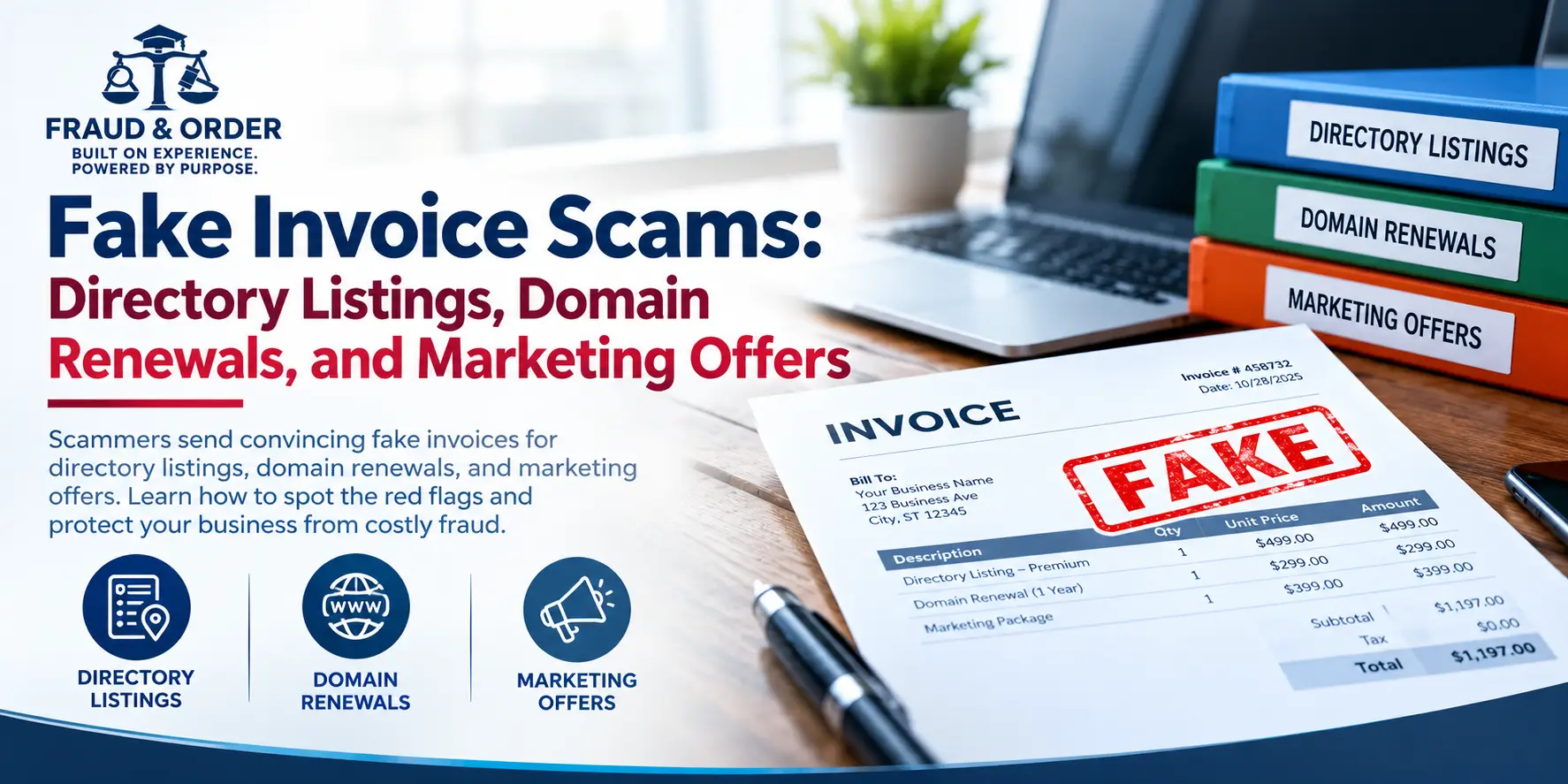
An envelope lands on the accounts payable desk. It names your company, lists your website domain, shows an account number and a due date, and asks for a few hundred dollars to keep a “listing” active. Nobody ordered it, but it looks routine, so it gets paid.
That is how fake invoice scams work. They hack nothing. They rely on public business data, busy staff, and the assumption that a bill means someone already said yes.
The numbers show why this matters. The FTC received about 3 million fraud reports in 2025 with $15.9 billion in reported losses, and imposter scams were again the most reported category. The FBI’s Internet Crime Complaint Center (IC3) recorded $20.88 billion in losses for 2025, up 26%, with business email compromise above $3 billion. And in February 2026, North Dakota’s Attorney General settled with a company that mailed invoice look-alikes to local businesses, churches, and nonprofits.
What Are Fake Invoice Scams?
Fake invoice scams are bills, or documents built to look like bills, for goods or services an organization never ordered. Some are outright fraud; others are solicitations with a disclaimer buried in fine print. Minnesota’s Attorney General lists directory listings, printer toner, compliance services, signs, and magazine subscriptions among the usual products.
Under 39 U.S.C. § 3001(d), a mailed solicitation that could reasonably be read as a bill must carry a conspicuous notice saying it is a solicitation, not a bill. If that notice is missing or hidden, the Postal Service treats the mailing as evidence of a false representation scheme. A disclaimer never creates a debt, though. If nobody agreed to buy, you owe nothing.
Directory Listing Scams: The “Renewal” That Never Was
Directory schemes usually start with a call to “verify” or “update” your existing listing. An invoice then claims an employee approved the order.
In one FTC case, Canadian operators called U.S. businesses claiming to renew directory listings. Staff agreed, thinking it was an existing relationship, and $299 invoices followed for listings the companies had never bought. The FTC banned the defendants from the directory business.
Watch for these signs:
- A “renewal” with no original contract or purchase order
- A vendor name resembling a well-known directory brand
- Collection threats or a recording of an employee saying “yes”
- Payment instructions outside your normal vendor channels
Outside billers and fictitious vendors exploit the same weak spot. Our guide to fake vendor and fictitious supplier fraud explains how investigators tell them apart.
Domain Renewal Scams: Turning Public Records Into Bills
Domain records are public, which makes them easy raw material for fake invoice scams. The FTC charged Toronto-based Internet Listing Service with mailing invoices, starting in 2004, that showed a business’s real domain or a close variation, such as .org for .com, and looked like they came from the registrar. The fee was really for a “website address listing,” and the FTC halted the operation in 2010.
North Dakota’s 2026 settlement involved mailers sent under names including Domain Networks and My Safe Domain, which investigators said were designed to look like bills from recipients’ own domain providers. The company agreed to refunds without admitting wrongdoing.
Two facts cut through the confusion:
- ICANN does not bill registrants. Only your registrar can renew your domain.
- Trademark owners face the same trick. The USPTO warns that private companies use public trademark data to send official-looking notices.
Marketing and SEO Offers Disguised as Bills
Many fake invoice scams sell marketing rather than infrastructure. Internet Listing Service bundled its notices with a promise to submit websites to 25 search engines four times a year. Today’s versions use labels like “search listing” or “online visibility package,” and some arrive by email with a payment link.
Emailed versions can also harvest credentials or redirect real payments. See our breakdowns of business email compromise and deepfake invoice fraud in accounts payable.
How to Stop Fake Invoice Scams: Controls That Work
Controls that block outside billers also block insiders. The ACFE’s Occupational Fraud 2026 report, covering 2,402 cases, found billing schemes in roughly 21% of them. Put these in place this quarter:
- No PO, no payment. Match every invoice to a purchase order and proof of delivery.
- One buyer for recurring services. The FTC recommends a single point person for listings, supplies, and subscriptions.
- Keep a digital asset register. Record each domain, registrar, renewal date, trademark, and paid listing. Turn on auto-renew and registrar lock.
- Verify new payees independently, with dual control over vendor master file changes.
- Train the front line. Reception and AP staff should never confirm company details to unsolicited callers.
- Use analytics to flag small, first-time invoices. See how data analytics reveals hidden schemes.
See also the internal controls that actually stop theft.
Already Paid? What to Do Next
Stop further payments, since paying can put you on lists for more fake invoice scams. Dispute the charge in writing and ask your bank or card issuer about a reversal. Report it to the FTC at ReportFraud.ftc.gov, your state attorney general, the U.S. Postal Inspection Service for mailed invoices, and IC3 for email schemes. Keep every record.
If an invoice was approved with no order behind it, ask why. Our first 48 hours after discovering fraud checklist and internal fraud investigation framework can help.
Conclusion: Verify Before You Pay
Fake invoice scams succeed on small amounts, familiar wording, and nobody asking a second question. A purchase order rule, a domain register, and trained staff will stop most of them before money moves.
If your organization has received or paid a suspicious invoice, contact FraudOrder to share what happened. Victims and whistleblowers can also reach our nonprofit partner, the Fraud & Order Foundation.
Frequently Asked Questions
1. Do we have to pay an invoice for something we never ordered?
No. You have no obligation to pay for goods or services your organization did not order.
2. Are fake invoice scams legal if the document says “this is not a bill”?
A disclaimer helps the sender meet postal rules, but it does not make deception lawful. The FTC and state attorneys general have acted against misleading invoice look-alikes repeatedly.
3. How can we tell a real domain renewal notice from a fake one?
Real renewal notices come only from your registrar, never from ICANN or an unfamiliar “listing” company. Log in to your registrar account directly rather than using any link in the notice.
4. Where should our business report fake invoice scams?
Report to the FTC at ReportFraud.ftc.gov and your state attorney general. Mailed invoices can also go to the U.S. Postal Inspection Service, and email schemes to the FBI at ic3.gov.
5. Can money paid on a fake invoice be recovered?
Sometimes. Card payments can often be disputed, and some state settlements include refunds, as in North Dakota in 2026.
6. Could an employee be involved?
It is possible. An outside biller may work with an insider, or an employee may create fictitious vendors. Repeated approvals without orders deserve an independent review.
References
- Association of Certified Fraud Examiners. (2026). Occupational Fraud 2026: A Report to the Nations. https://www.acfe.com/fraud-resources/report-to-the-nations
- Federal Bureau of Investigation, Internet Crime Complaint Center. (2026). 2025 Internet Crime Report. https://www.ic3.gov/AnnualReport/Reports/2025_IC3Report.pdf
- Federal Trade Commission. (2026). FTC Testifies Before Joint Economic Committee on Agency’s Efforts to Combat Fraud. https://www.ftc.gov/news-events/news/press-releases/2026/03/ftc-testifies-joint-economic-committee-agencys-efforts-combat-fraud
- Federal Trade Commission. (n.d.). Scams and Your Small Business: A Guide for Business. https://www.bulkorder.ftc.gov/system/files/publications/scams_and_your_small_business.pdf
- Federal Trade Commission. (2010). FTC Halts Cross Border Domain Name Registration Scam. https://www.ftc.gov/node/47019
- North Dakota Attorney General. (2026). Attorney General Wrigley Announces Settlement With Company Behind Deceptive Invoice Solicitations. https://attorneygeneral.nd.gov/attorney-general-wrigley-announces-settlement-with-company-behind-deceptive-invoice-solicitations/
- Minnesota Attorney General. (n.d.). Look Out for Fake Invoices Aimed at Businesses and Other Organizations. https://www.ag.state.mn.us/consumer/Publications/FakeInvoices.asp
- ICANN. (2014). Be Careful What You Click: Alert of New Fraudulent Domain Renewal Emails. https://www.icann.org/en/blogs/details/be-careful-what-you-click-alert-of-new-fraudulent-domain-renewal-emails-29-9-2014-en
- United States Patent and Trademark Office. (n.d.). Solicitation Warnings. https://www.uspto.gov/trademarks/solicitation_warnings.jsp
- Legal Information Institute, Cornell Law School. (n.d.). 39 U.S. Code § 3001: Nonmailable Matter. https://www.law.cornell.edu/uscode/text/39/3001
Disclaimer
This article is for informational purposes only and is not legal, financial, or professional advice. Reading it does not create a client relationship with FraudOrder. Consult qualified professionals about your specific situation. For questions about FraudOrder services, visit https://fraudorder.co/