
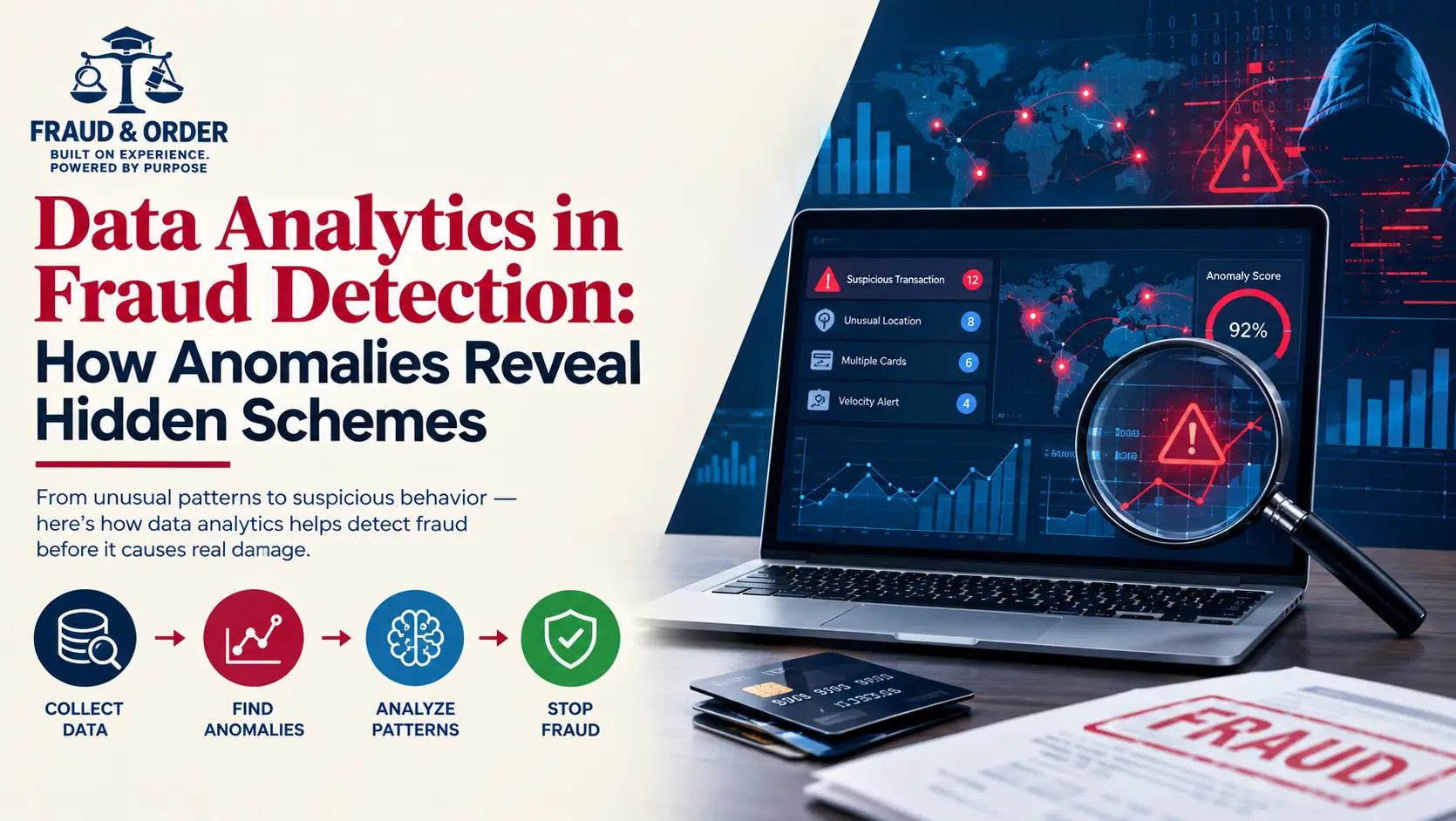
Most fraud hides in plain sight, inside thousands of ordinary transactions nobody has time to read.
The ACFE’s Occupational Fraud 2026: A Report to the Nations analyzed 2,402 cases across 143 countries with more than $3.4 billion in losses. The median scheme ran for 12 months before anyone caught it, and internal audit uncovered only 15% of cases. Outside threats are climbing too: the FBI’s Internet Crime Complaint Center recorded nearly $20.9 billion in reported 2025 losses, up 26%, including about $3 billion from business email compromise.
The good news: every scheme leaves a statistical trail. Data analytics in fraud detection turns that trail into something you can test and act on. This guide covers how anomalies expose fraud, which tests to run first, and how to build a program that holds up.
Why Anomalies Are the Fingerprints of Fraud
Fraud has to move something: money, inventory, records, or access. Moving it quietly usually breaks a normal pattern.
A real vendor bills irregular amounts on a predictable schedule. A fake vendor often bills round numbers, just under an approval limit, to an address matching an employee’s. Each detail looks harmless alone. Together, they form a pattern.
That is the core idea behind data analytics in fraud detection: define normal, then flag what doesn’t fit. You are not accusing anyone. You are narrowing thousands of transactions to the few that deserve a human look.
Six Anomaly Tests Every Organization Should Run
You do not need a data science team. These tests use data already in your accounting and payroll systems:
- Duplicate payments. Same vendor, amount, and similar invoice number. Some are honest errors; others are deliberate double billing.
- Vendor and employee matches. Compare vendor addresses, phones, and bank accounts with employee records. A match is a classic shell company sign.
- Threshold clustering. Look for invoices or expenses that sit just below approval limits. A spike at $4,950 when the limit is $5,000 is rarely a coincidence.
- Round-number patterns. Real costs are messy. Too many even amounts can point to invented figures.
- Timing anomalies. Flag journal entries posted on weekends, late at night, or at period end, especially by users who rarely post them.
- Bank account changes before payment. A vendor’s banking details changed days before a large wire is a classic sign of business email compromise.
A note on Benford’s law. This test compares the leading digits of your numbers against the frequencies naturally occurring data tends to follow. Forensic accountant Mark Nigrini cautions that it works best on large populations; datasets under about 5,000 records raise the risk of false alarms. A deviation is a reason to look closer, not proof of wrongdoing.
Real-World Proof: Analytics at Enforcement Scale
Federal enforcement shows what data analytics in fraud detection can do at scale. In June 2026, the Department of Justice announced its National Health Care Fraud Takedown: 455 defendants charged in connection with more than $6.5 billion in alleged fraud. Prosecutors credited the Criminal Division’s Data Fusion Center, which uses advanced analytics to spot emerging schemes. In the same action, CMS suspended 1,079 providers and revoked billing privileges for 1,403 more.
Regulators expect the same discipline from companies. The DOJ’s Evaluation of Corporate Compliance Programs asks whether compliance staff can access relevant data, whether the company uses analytics tools, and how it measures their accuracy. Weak data analytics in fraud detection can now shape how prosecutors view your compliance program. Healthcare organizations should also review our healthcare fraud investigation services.
Where Analytics Falls Short
Data analytics in fraud detection is powerful, but it is not a complete program:
- People still catch the most fraud. Tips detected 43% of cases in the 2026 ACFE study, more than any other method. Analytics works best alongside a whistleblower hotline employees actually use.
- Behavior matters as much as numbers. The ACFE found that 84% of perpetrators showed at least one behavioral red flag, such as living beyond their means, before detection. Data can’t see that alone.
- A flag is not a finding. Every anomaly needs follow-up and context before conclusions.
- Evidence must survive scrutiny. If a flag turns into an investigation, preserve data properly from the start. Our guides on following the digital trail and recovering deleted evidence explain why.
Adoption is growing. In the 2024 ACFE and SAS Anti-Fraud Technology Benchmarking Report, 91% of organizations said they use data analysis in their anti-fraud programs, and 83% expected to implement generative AI within two years. Tools alone don’t close the gap. Judgment does.
A 30-Day Plan to Get Started
You can launch practical data analytics in fraud detection within a month:
- Week 1: Map your data. Find where payments, vendors, payroll, and journal entries live.
- Week 2: Run three tests. Start with duplicate payments, vendor and employee matches, and bank account changes.
- Week 3: Review the hits. Clear honest errors and document the rest.
- Week 4: Make it routine. Schedule the tests monthly, assign an owner, and set a clear escalation path to legal counsel when something looks serious.
If an anomaly points to possible corporate embezzlement, get professional help before confronting anyone, or evidence may disappear.
Turn Your Data Into Your First Line of Defense
Fraudsters count on volume to bury their tracks. Data analytics in fraud detection flips that advantage: the more transactions you have, the clearer the anomalies become. Start small, document everything, and pair your analytics with people who know what to do next. When a pattern doesn’t add up, FraudOrder’s investigators can help you find out why, with the accuracy and integrity your case demands.
Frequently Asked Questions
What is data analytics in fraud detection?
It is the use of data tests and models to find transactions or behaviors that break normal patterns, such as duplicate payments or vendor and employee matches. People then review flagged items before drawing conclusions.
Do small businesses need fraud analytics?
Yes. Data analytics in fraud detection can start with spreadsheet tests for duplicate payments and vendor matches, which cost little and catch common schemes. Smaller organizations often have fewer controls, so basic monitoring is even more valuable.
Can analytics prove that fraud happened?
No. Analytics finds anomalies worth reviewing, and many have innocent explanations. Proving fraud requires investigation, documentation, and often forensic evidence.
How often should we run anomaly tests?
Monthly is a practical start, with higher-risk areas such as payments reviewed more often. A simple test run every month beats a sophisticated one run once a year.
What should we do if a test flags a current employee?
Do not confront the person. Preserve the data, limit who knows, and contact legal counsel and a qualified investigator. Acting too quickly can compromise evidence and create legal risk.
When should we bring in an outside fraud investigator?
Bring one in when an anomaly suggests intentional misconduct, involves senior staff, or could lead to litigation or regulatory reporting. An independent investigator adds objectivity and handles evidence properly.
References
- Association of Certified Fraud Examiners. (2026). Key findings from Occupational Fraud 2026: A Report to the Nations. https://www.acfe.com/about-the-acfe/newsroom-for-media/press-releases/press-release-detail?s=report-to-the-
- Federal Bureau of Investigation, Internet Crime Complaint Center. (2026). 2025 Internet crime report. https://www.ic3.gov/AnnualReport/Reports/2025_IC3Report.pdf
- U.S. Department of Justice. (2026). National Health Care Fraud Takedown results in 455 defendants charged in connection with over $6.5 billion in alleged fraud. https://www.justice.gov/opa/pr/national-health-care-fraud-takedown-results-455-defendants-charged-connection-over-65
- U.S. Department of Justice, Criminal Division. (2024). Evaluation of corporate compliance programs. https://www.justice.gov/criminal/criminal-fraud/page/file/937501/dl
- Nigrini, M. J. (2022). Using Benford’s law to reveal journal entry irregularities. Journal of Accountancy (AICPA). https://www.journalofaccountancy.com/issues/2022/sep/using-benfords-law-reveal-journal-entry-irregularities.html
- Association of Certified Fraud Examiners & SAS. (2024). Anti-fraud technology benchmarking report. https://www.sas.com/content/dam/SAS/documents/infographics/2024/acfe-anti-fraud-technology-benchmark-report-infographic-113777.pdf
- Akin Gump Strauss Hauer & Feld. (2026). The 2026 National Health Care Fraud Takedown: A data-driven, whole-of-government approach to preventing fraud. https://www.akingump.com/en/insights/alerts/the-2026-national-health-care-fraud-takedown-a-data-driven-whole-of-government-approach-to-preventing-fraud
Disclaimer
This article is for informational purposes only and is not legal, financial, or professional advice. Reading it does not create a client relationship with FraudOrder. Consult qualified legal, accounting, or investigative professionals about your specific situation. For questions about FraudOrder services, visit https://fraudorder.co/