
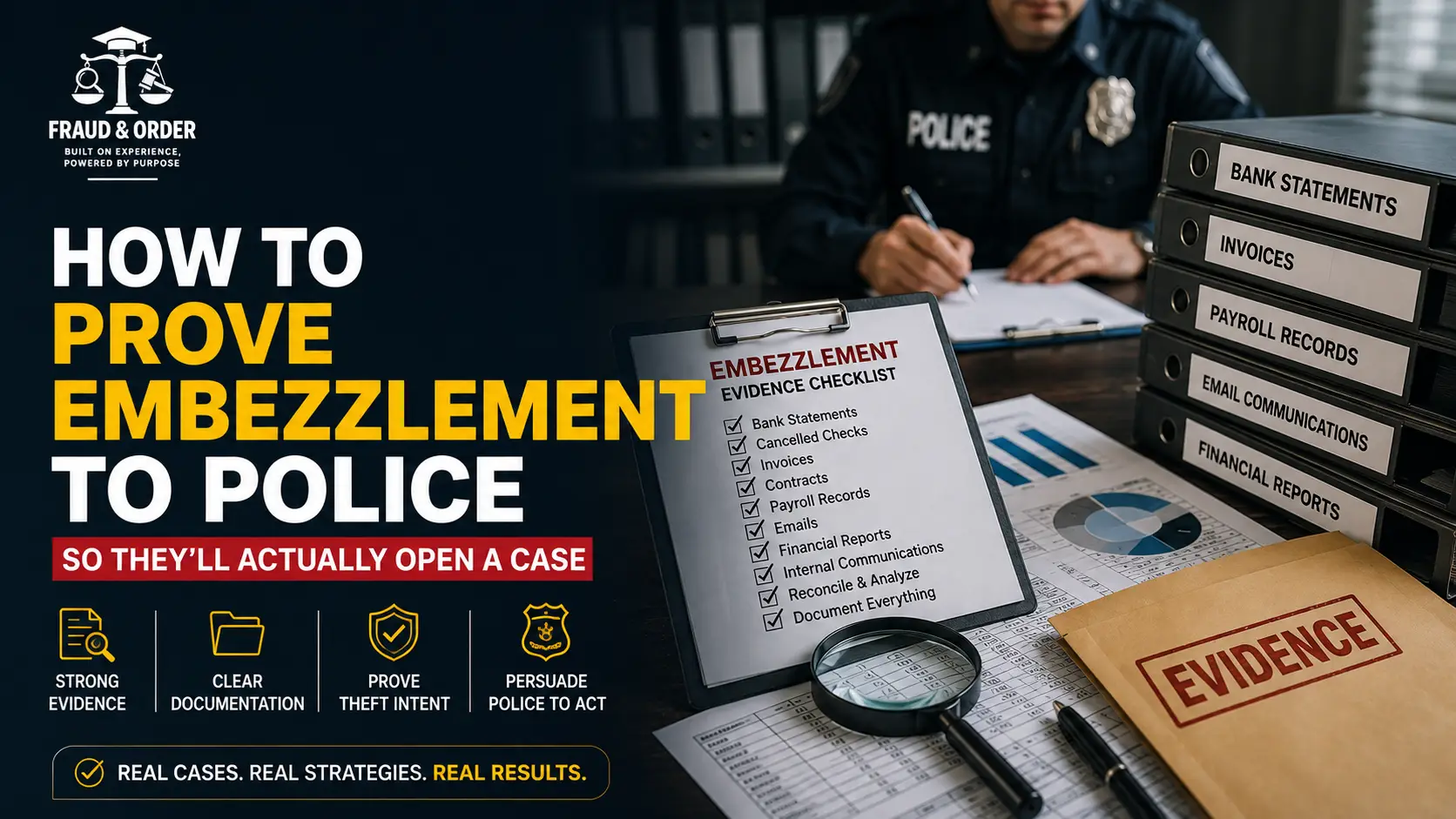
You discovered the theft, you know who did it, and you walked into the police station expecting action. Instead you got a shrug, a case number that goes nowhere, and the sinking feeling that nothing will happen. If that sounds familiar, you are not alone, and it is not your fault. Here is the uncomfortable truth: estimates suggest fewer than half of employees who embezzle are ever arrested and prosecuted. Combine that with ACFE data showing the typical occupational fraud runs about 12 months before detection and costs a median of $145,000, and you can see the problem. By the time most businesses report embezzlement, the trail is cold and the paperwork is thin.
The good news? You can dramatically improve your odds. Police and prosecutors are not dismissing you out of spite. They are triaging limited resources, and a well-documented case is far more likely to get picked up. This guide walks through exactly how to prove embezzlement to police so they will actually open a case, step by step.
Why Police Turn Embezzlement Cases Away
To prove embezzlement, understanding the “why” police say no is the first step. Financial crimes units are stretched thin, and embezzlement cases are document-heavy and time-consuming to prove. When a business shows up with a hunch and a shoebox of receipts, officers often cannot justify the hours required.
Embezzlement is legally specific: it is the fraudulent taking of property by someone the owner entrusted with it. To prove embezzlement, prosecutors generally must establish a few elements: a relationship of trust, that the property was entrusted to the suspect, that they took or converted it for personal use, and that they did so with intent. If your report does not clearly connect the dots on each element, your effort to prove embezzlement looks weak before anyone opens it.
The lesson is simple. Do not bring police a suspicion. Bring them a case that is already most of the way to proven.
What Police Actually Need to Open a Case
District attorney offices that handle these crimes are refreshingly direct about what they need. The victim usually understands the business better than any outside investigator ever could, so your documentation carries enormous weight. To prove embezzlement effectively, assemble a clear, organized package rather than a pile of raw records.
At minimum, aim to provide:
- A clear timeline. When the scheme started, when you discovered it, and how it unfolded.
- The suspect’s role and access. Job title, duties, and exactly what funds, accounts, or assets they were entrusted with.
- The financial trail. Bank statements, checks, invoices, ledgers, and any records showing money moving from the company to the suspect or their benefit.
- A quantified loss. A specific dollar figure, supported by documentation, not an estimate.
- How the theft was concealed. Falsified entries, forged approvals, or manipulated records that show intent.
Organized evidence is what separates a case police open from one they file away, and it is the core of how you prove embezzlement. If you want a deeper look at the financial records that matter most, our guide on what fraud investigators look for in bank statements breaks it down.
Build the Evidence the Right Way
How you gather evidence matters as much as what you gather. Sloppy collection can taint otherwise strong proof and hand a defense attorney an easy way to get it excluded. To prove embezzlement in a way that survives scrutiny, protect the integrity of your records from day one.
Do this:
- Preserve original documents and work from copies. Maintain a documented chain of custody so no one can claim records were altered.
- Secure digital evidence immediately, including email, accounting software logs, and access records, before anything can be deleted.
- Keep a written record of who accessed what and when during your internal review.
- Quantify precisely. A forensic accountant can trace the flow of funds and produce a loss figure that withstands cross-examination.
Avoid this:
- Do not confront the suspect before you are ready. It can trigger evidence destruction or tip off co-conspirators.
- Do not delete, reorganize, or “clean up” files. You may destroy proof of intent or concealment.
- Do not rely on hearsay. Police need first-hand documentation, not secondhand assumptions.
This is often where professional help pays for itself. A forensic accountant packages messy financial data into the clear, quantified narrative prosecutors need. Our step-by-step guide to forensic accounting investigations shows how that process works.
How to Present Your Case to Law Enforcement
Presentation is the final piece of any effort to prove embezzlement. Once your evidence is solid, package it so a busy detective can grasp it in minutes.
- Lead with a one-page summary. State who did what, when, how much was taken, and how you know.
- Provide a tabbed, indexed evidence binder. Make it effortless to follow the money.
- Match evidence to the legal elements of embezzlement so the case for each element is obvious.
- Bring in professional credibility. A report from a Certified Fraud Examiner or forensic accountant signals that your case is real and prosecutable.
- Know where to file. Report to the local agency that serves your business’s location, and ask for the financial crimes unit if one exists.
Remember, you are essentially doing the detective’s early work for them. The easier you make it to say yes, the more likely they will.
When to Bring in a Professional
Some situations demand outside expertise to prove embezzlement before you ever contact police. If the loss is significant, spans multiple accounts or years, or involves someone senior, a professional dramatically strengthens your case. Forensic accountants and fraud examiners speak the language prosecutors trust, and their independence adds credibility internal teams often cannot.
If you are weighing whether to pursue recovery too, our overview of legal options to recover money from an embezzling employee covers civil and criminal paths that often run in parallel.
Turn a Cold Report Into an Open Case
Proving embezzlement to police is not about luck or connections. You prove embezzlement by walking in with organized, quantified, professionally supported evidence that maps cleanly to the crime. Do that, and you shift from being one more dismissed complaint to a case a prosecutor wants to win.
If you suspect embezzlement in your organization, do not gamble your one shot on a weak first report. Reach out to FraudOrder to build a case that police and prosecutors can actually act on, from the very first document.
Frequently Asked Questions
Why won’t the police open my embezzlement case?
Financial crimes units are under-resourced and embezzlement cases are document-heavy, so officers triage based on how prosecutable a case looks. If you arrive with suspicion rather than organized, quantified evidence, the case appears weak and gets deprioritized. The fix is to present a clear package that maps your evidence to each legal element of the crime.
How much evidence do I need to prove embezzlement?
Enough to establish the core elements: that the suspect was entrusted with property, that they took or converted it for personal use, and that they did so intentionally. In practice that means a documented timeline, the financial trail, a quantified loss, and proof of concealment. Quality and organization matter more than sheer volume.
Should I confront the employee before going to the police?
Generally no. Confronting a suspect early can trigger evidence destruction, asset movement, or coordination among co-conspirators, and it can compromise your case. It is usually better to preserve evidence quietly and seek professional or legal guidance first. Discretion in the early stage protects your options.
Do I need a forensic accountant to report embezzlement?
Not always, but it helps significantly in larger or more complex cases. A forensic accountant can trace the flow of funds, quantify losses precisely, and produce findings that withstand legal scrutiny, which adds credibility with police and prosecutors. For multi-account or multi-year schemes, professional analysis often makes the difference between a case opened and one declined.
How long do I have to report embezzlement?
Time limits vary by jurisdiction and the amount involved, and criminal statutes of limitations differ from civil ones. Because delay lets evidence disappear and losses grow, reporting sooner is almost always better regardless of the deadline. Consult a qualified attorney about the specific limitations that apply to your situation.
Can I pursue criminal charges and recover my money at the same time?
Often yes. Criminal prosecution and civil recovery are separate tracks that can run in parallel, and criminal cases can sometimes result in restitution orders. An attorney and a forensic accountant can help you coordinate both paths effectively. The right strategy depends on the specifics of your case.
References
- Association of Certified Fraud Examiners. (2024). Occupational Fraud 2024: A Report to the Nations. https://legacy.acfe.com/report-to-the-nations/2024/
- Federal Bureau of Investigation. (2024). White-Collar Crime. https://www.fbi.gov/investigate/white-collar-crime
- Federal Bureau of Investigation. (2025). 2024 Internet Crime Report. https://www.fbi.gov/news/press-releases/fbi-releases-annual-internet-crime-report
- U.S. Department of Justice. (2024). Criminal Fraud Section. https://www.justice.gov/criminal/criminal-fraud
- San Diego County District Attorney. (2024). Helping Victims of Embezzlement. https://www.sdcda.org/helping/embezzlement
- Justia. (2025). Embezzlement Laws. https://www.justia.com/criminal/offenses/theft-crimes/embezzlement/
- American Institute of Certified Public Accountants. (2024). Forensic and Valuation Services. https://www.aicpa-cima.com/topic/forensic-valuation
- Association of Certified Fraud Examiners. (2024). Fraud Examiners Manual. https://www.acfe.com/training-events-and-products/all-products/fraud-examiners-manual
Disclaimer: This article is for informational and educational purposes only. It does not constitute legal, financial, or professional advice, and reading it does not create a client relationship of any kind. Every embezzlement situation is unique; consult a qualified attorney, forensic accountant, or certified fraud examiner before taking action in your specific case. For questions about FraudOrder services, visit https://fraudorder.co/