
In June 2026, federal prosecutors announced the largest health care fraud takedown in U.S. history by number of defendants: 455 people charged across 56 federal districts, tied to more than $6.5 billion in alleged false claims. Just months earlier, the Department of Justice reported a record $6.8 billion in False Claims Act recoveries for fiscal year 2025, with more than $5.7 billion of that tied to health care.
Those numbers are not abstract. The National Health Care Anti-Fraud Association conservatively estimates that fraud drains about 3% of total U.S. health spending, and some government estimates run as high as 10%. Behind most of those losses sit three familiar healthcare fraud schemes: upcoding, phantom billing, and kickbacks.
For compliance officers, practice owners, and auditors, understanding how these healthcare fraud schemes actually operate is the first step to catching them early. Here is what they look like in practice and what your organization can do today.
Upcoding: When the Bill Tells a Bigger Story Than the Visit
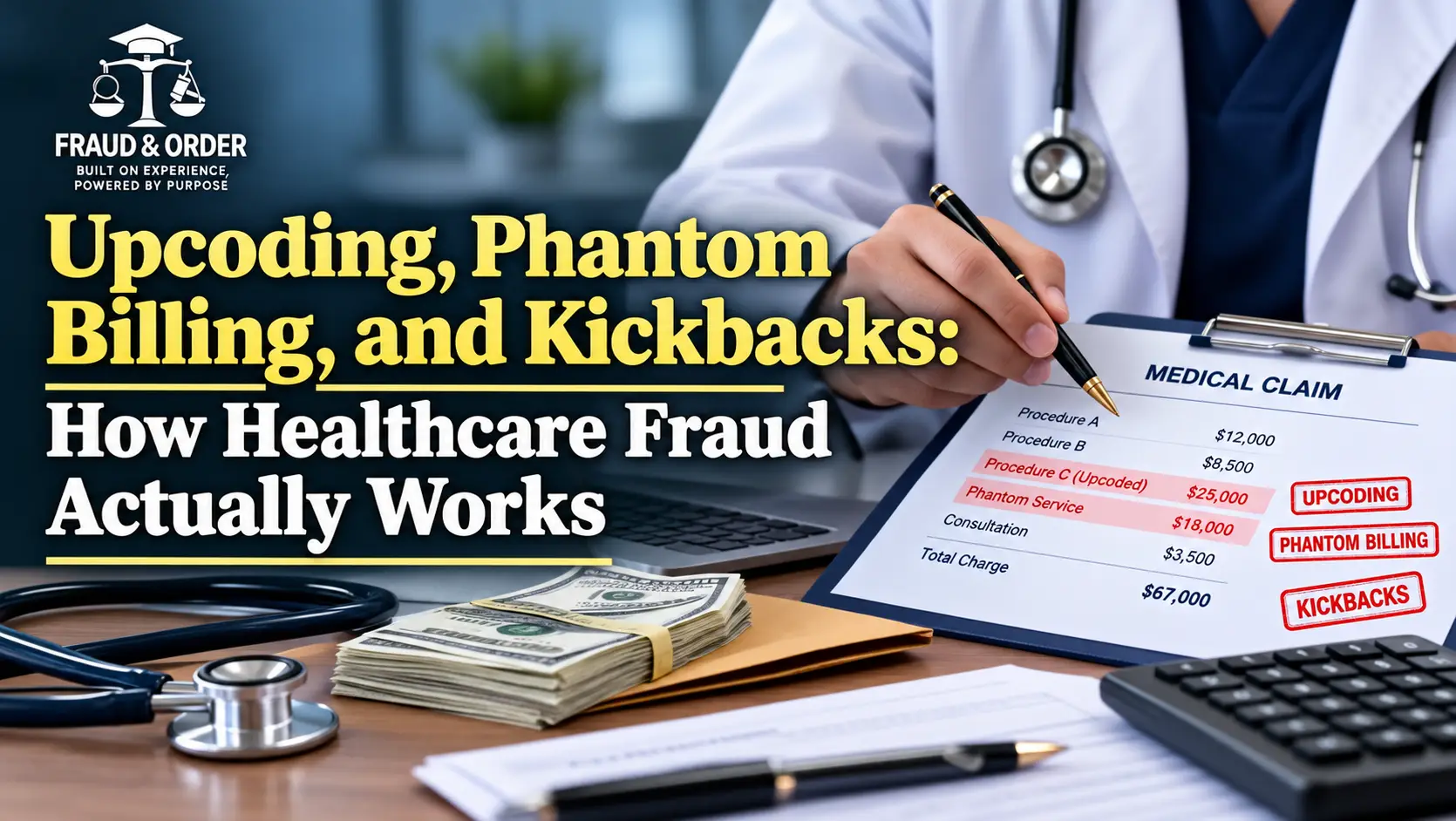
Among all healthcare fraud schemes, upcoding is one of the most common. It means billing for a more complex, expensive service or diagnosis than the patient actually received. A routine 15-minute follow-up gets coded as a high-complexity visit. A minor wound is billed as a severe one. Each claim looks only slightly inflated, which is exactly why it is hard to spot.
Upcoding has also moved into Medicare Advantage, where payments depend on how sick patients appear on paper. In its FY2025 enforcement summary, the DOJ highlighted multiple large settlements involving allegedly unsupported diagnosis codes submitted to inflate those risk-adjusted payments.
Common red flags include:
- A provider billing the highest-level visit codes far more often than peers
- Diagnoses that appear on claims but have no support in clinical notes
- Sudden jumps in coding intensity after new billing staff or software
- Copy-and-paste documentation that looks identical across patients
For a deeper look at a closely related tactic, see our breakdown of upcoding and unbundling in healthcare.
Phantom Billing: Charging for Care That Never Happened
Phantom billing, also called billing for services not rendered, is the bluntest of the major healthcare fraud schemes. The provider submits claims for visits, tests, equipment, or patients that never existed.
The 2026 takedown offered a striking example. Prosecutors alleged that one social adult day care operation billed Medicaid for hundreds of beneficiaries per day, even though the facility could hold only about 30 people. Medicaid-related cases made up the largest share of that takedown, with 295 defendants charged in connection with more than $518 million in alleged false claims.
Phantom billing often relies on stolen or purchased patient identities, deceased beneficiaries, or real patients who were never treated. We walk through how these operations are built in our article on ghost patients and clinics that bill for services never rendered.
Kickbacks: The Hidden Engine Behind Many Schemes
Kickbacks are payments, gifts, or anything of value offered in exchange for patient referrals or orders for items billed to federal health programs. The federal Anti-Kickback Statute makes these arrangements a crime, and claims tainted by kickbacks can also trigger False Claims Act liability.
What makes kickbacks dangerous is that they often power the other healthcare fraud schemes. In the 2026 takedown, prosecutors alleged that a wound care allograft scheme generated more than $4 billion in Medicare claims, with marketers allegedly receiving roughly 40% of the proceeds as kickbacks. Those charges remain allegations until proven in court.
Kickbacks rarely look like envelopes of cash. They are often disguised as:
- “Marketing” or “consulting” fees tied to referral volume
- Medical director payments with no real duties
- Free rent, staff, or equipment for referring physicians
- Sham speaker programs and lavish meals
Our guide to pharmaceutical kickbacks covers how these payments are structured and hidden in the books.
How Investigators Uncover Healthcare Fraud Schemes
Most healthcare fraud schemes leave a data trail. Investigators and forensic accountants typically combine several methods:
- Claims data analytics: Comparing billing patterns against peers to find outliers in codes, volume, or patient counts. The DOJ now uses a Data Fusion Center that blends claims analysis with financial intelligence.
- Documentation sampling: Pulling a statistically valid sample of medical records and checking whether they support what was billed.
- Financial tracing: Following payments to marketers, shell companies, and related parties to expose kickback flows.
- Interviews and tips: The ACFE’s 2026 Report to the Nations found that 43% of occupational frauds were detected through tips, more than any other method, and more than half of those tips came from employees.
For the full process, see how healthcare fraud investigations actually work.
Whistleblowers play an enormous role in exposing healthcare fraud schemes. According to the DOJ, a record 1,297 qui tam lawsuits were filed in FY2025. To understand what typically sparks federal attention, read what triggers a federal healthcare fraud investigation.
Practical Steps to Protect Your Organization Now
You do not need a massive compliance department to reduce exposure to healthcare fraud schemes. Start with these steps:
- Run a coding audit. Compare your top billing codes against specialty benchmarks and review a sample of charts against claims.
- Map every referral relationship. Document the fair market value and legitimate business purpose of every payment to or from a referral source.
- Separate duties. The person who codes claims should not be the only person reviewing them or reconciling payments.
- Monitor exclusion lists. Screen employees and vendors against the HHS OIG exclusion list monthly.
- Create a safe reporting channel. Staff who see something wrong should have an easy, confidential way to raise it internally first. Our guide on how to report healthcare fraud explains the external options too.
- Train your team. The ACFE found that organizations training both staff and managers had a median fraud loss of $84,000, versus $150,000 for those with no training. Make sure coders and front-desk staff can recognize healthcare fraud schemes.
- Act quickly on red flags. Early, independent review limits both financial loss and legal exposure.
Smaller practices are often the most exposed. Our guide on protecting a small medical practice from billing fraud offers a focused checklist.
Conclusion: Integrity Is Your Best Defense
Upcoding, phantom billing, and kickbacks are not complicated ideas. They persist because they hide inside routine claims, trusted relationships, and busy billing departments. With federal enforcement at record levels and data analytics sharper than ever, the risk of ignoring these healthcare fraud schemes has never been higher.
The good news is that strong internal controls, regular audits, and early independent review can stop problems before they become investigations. If you suspect billing irregularities or want an objective assessment of your exposure, FraudOrder’s forensic accountants and fraud investigators can help you find the facts, protect your organization, and move forward with confidence.
Frequently Asked Questions
1. What is the difference between healthcare fraud and billing errors?
The key difference is intent. Honest coding mistakes happen, but fraud involves knowingly submitting false claims or acting with reckless disregard for accuracy. A pattern of errors that always favors higher payment is a warning sign worth investigating.
2. Can a practice owner be liable for fraud committed by billing staff?
Yes, potentially. Under the False Claims Act, organizations can face liability if they knew or should have known about false claims, and weak oversight can be viewed as reckless disregard. Strong controls and documented audits are an important defense.
3. What are the penalties for violating the Anti-Kickback Statute?
Violations can bring criminal fines, prison time, civil monetary penalties, and exclusion from federal health programs. Claims tainted by kickbacks can also create False Claims Act liability with treble damages and per-claim penalties.
4. How does FraudOrder investigate suspected healthcare billing fraud?
Our team combines claims analysis, medical record sampling, financial tracing, and interviews to determine what happened and how much was lost. We document findings to evidentiary standards so they can support legal counsel, insurers, or regulators.
5. Should we self-disclose if we find overbilling?
Organizations that identify Medicare or Medicaid overpayments generally have a legal duty to report and return them within set timeframes. Speak with qualified healthcare counsel before making any disclosure, and consider an independent forensic review to quantify the issue accurately.
6. How quickly can FraudOrder begin an investigation?
We typically start with a confidential consultation to understand your concerns and scope the work. From there, we can move quickly to secure records and data before evidence is lost or altered.
References
- U.S. Department of Justice. (2026). National Health Care Fraud Takedown Results in 455 Defendants Charged in Connection with Over $6.5 Billion in Alleged Fraud. https://www.justice.gov/opa/pr/national-health-care-fraud-takedown-results-455-defendants-charged-connection-over-65
- U.S. Department of Justice. (2026). Fact Sheet: False Claims Act Settlements and Judgments, Fiscal Year 2025. https://www.justice.gov/opa/media/1424126/dl
- HHS Office of Inspector General. (2026). 2026 National Health Care Fraud Takedown. https://oig.hhs.gov/fraud/enforcement/2026-national-health-care-fraud-takedown/
- HHS Office of Inspector General. (2026). Spring 2026 Semiannual Report to Congress. https://oig.hhs.gov/reports/all/2026/spring-2026-semiannual-report-to-congress/
- National Health Care Anti-Fraud Association. (2025). The Challenge of Health Care Fraud. https://www.nhcaa.org/tools-insights/about-health-care-fraud/the-challenge-of-health-care-fraud/
- Association of Certified Fraud Examiners. (2026). Occupational Fraud 2026: A Report to the Nations. https://www.acfe.com/fraud-resources/report-to-the-nations
- Seyfarth Shaw LLP. (2026). DOJ Reports Record $6.8 Billion in False Claims Act Recoveries for FY 2025. https://www.seyfarth.com/news-insights/doj-reports-record-dollar68-billion-in-false-claims-act-recoveries-for-fy-2025.html
- HHS Office of Inspector General. (2025). Fraud and Abuse Laws. https://oig.hhs.gov/compliance/physician-education/fraud-abuse-laws/
- Medical Economics. (2026). 455 Defendants Charged in Massive $6.5 Billion Health Care Fraud Takedown. https://www.medicaleconomics.com/view/455-defendants-charged-in-massive-6-5-billion-health-care-fraud-takedown
Disclaimer
This article is for informational purposes only and is not legal, financial, or professional advice; reading it does not create a client relationship with FraudOrder. Enforcement allegations described here are unproven unless established in court. Consult qualified professionals about your specific situation. For questions about FraudOrder services, visit https://fraudorder.co/